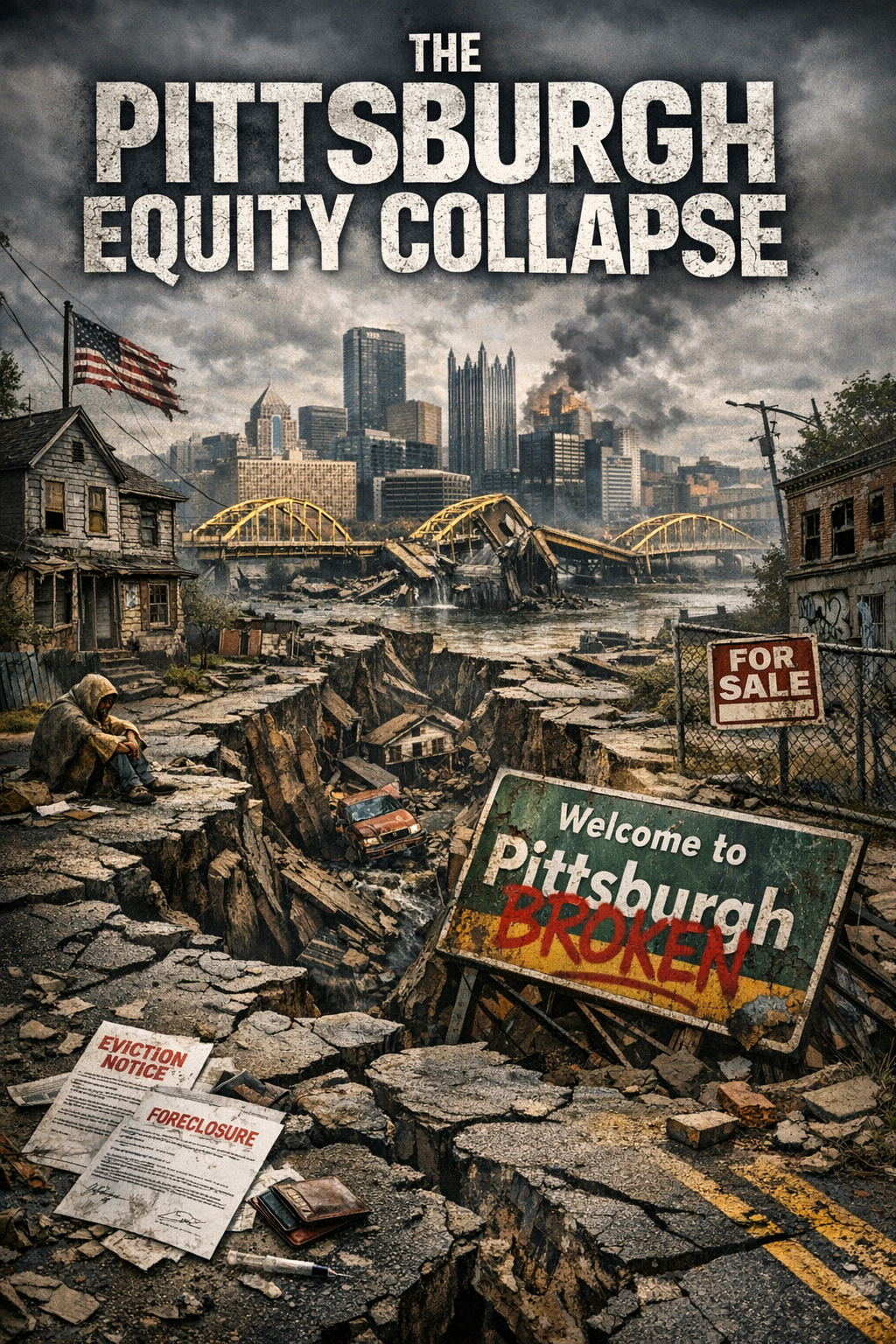
The Pittsburgh Equity Collapse: A Crisis Hiding in Plain Sight
There is a phrase that now defines the moral emergency unfolding in Western Pennsylvania, The Pittsburgh Equity Collapse. It is the only language that captures the scale of institutional neglect, the depth of generational harm, financial mismanagement, and racial abandonment that ADOS communities in Pittsburgh and Allegheny County have endured for generations.
This collapse is not metaphorical. It is measurable. It is documented. It is deadly.
For decades, ADOS communities have lived the consequences of institutional neglect that others only read about in reports. We buried loved ones too soon. We have watched neighborhoods stripped of opportunity. We have seen our children inherit barriers they did not build.
And it is being allowed to continue in a region that boasts some of the wealthiest nonprofit institutions in the United States, UPMC, Carnegie Mellon University, the University of Pittsburgh, and a philanthropic sector that collectively controls billions in assets.
A philanthropic and nonprofit landscape that has mastered the art of appearing generous while structurally starving ADOS‑led organizations and entire communities of the resources required to repair the damage.
Yet the communities most harmed by the region’s history, the communities whose ancestors-built Pittsburgh’s industrial wealth, remain locked in conditions that national researchers have called “one of the worst urban environments for Black Americans in the country.” That is The Pittsburgh Equity Collapse.
A Region of Wealth Built on the Backs of ADOS Families
Pittsburgh’s prosperity was constructed through the labor, displacement, and exclusion of Black Pittsburghers. Steelworkers, domestic workers, laborers, and displaced residents whose sacrifices fueled the rise of the very institutions that now claim to be engines of progress. The very institutions that benefited from that history have failed to invest in repairing the damage.
The data is staggering:
Black women in Pittsburgh are more likely to die during pregnancy or childbirth than in 97% of U.S. cities Source: Pittsburgh Gender Equity Commission Report Pittsburgh’s Inequality Across Gender and Race | DocumentCloud
Black maternal mortality in Pittsburgh is worse than 98% of comparable cities Pittsburgh’s Black residents feel consequences of inequality more starkly than in other U.S. cities, new city report finds – Pittsburgh’s Public Source
Black household income in Pittsburgh is less than half that of white households. https://www.census.gov/data.html
Black children in Allegheny County are five times more likely to live in poverty. KIDS COUNT Data Center from the Annie E. Casey Foundation
Black homeownership in Pittsburgh has collapsed to Depression‑era levels. Driving impact by equipping changemakers with evidence and solutions. | Urban Institute
Black economic mobility remains severely restricted, with Black children born in Pittsburgh far less likely to rise economically than their white peers. The Opportunity Atlas
This is not a coincidence. These are not abstract statistics. These are lived experiences. These are funerals, foreclosures, missed opportunities, generational wounds, and the predictable outcome of decades of institutional underinvestment in ADOS communities. A defining feature of The Pittsburgh Equity Collapse.
The Nonprofit Titans Who Benefit While ADOS Communities Bleed
Pittsburgh’s largest institutions are not passive observers. They are active beneficiaries of the region’s inequities.
UPMC, Carnegie Mellon University, the University of Pittsburgh, and the region’s major philanthropic foundations hold extraordinary power.
They shape policy, development, land use, health outcomes, and economic opportunity. They receive tax exemptions, public subsidies, and federal research dollars. They control billions in assets.
Yet their investment in ADOS communities remains inconsistent, insufficient, and structurally misaligned with the scale of the crisis.
UPMC
A global healthcare empire built on public resources, yet Black Pittsburghers experience some of the worst health outcomes in the nation. It’s one of the largest nonprofit health systems in the world with over $26 billion in annual revenue and pays no property taxes on vast real estate holdings.
UPMC’s growth has been fueled by public subsidies, tax exemptions, and land acquisitions all while the communities most harmed by health inequity receive symbolic, inconsistent, or short‑term support.
University of Pittsburgh & Carnegie Mellon University
Universities with multibillion‑dollar endowments that drive innovation, gentrification, and regional planning, yet ADOS enrollment, faculty representation, and community investment remain disproportionately low.
These institutions shape the region’s economy, housing market, and workforce pipelines. Their decisions determine who thrives and who is left behind. And for decades, ADOS communities have been left behind. This is The Pittsburgh Equity Collapse in real time.
Philanthropy in Pittsburgh: Generous on Paper, Absent in Practice
Pittsburgh is often celebrated as a “philanthropic capital.” But the truth is far more troubling. Celebrated nationally for its generosity, yet ADOS‑led organizations receive a fraction of the funding awarded to white‑led institutions that “serve” Black communities
National studies show that Black‑led nonprofits receive 76% less unrestricted funding, less than half the average revenue, and far fewer multi‑year commitments Source: Echoing Green & Bridgespan https://www.bridgespan.org/insights/library/philanthropy/race-to-lead
Local data mirrors this pattern. Pittsburgh’s philanthropic giants, Heinz Endowments, Hillman Foundation, RK Mellon Foundation, and others have long histories of funding white‑led organizations to “serve” Black communities while underfunding Black‑led institutions that actually represent those communities.
This is not philanthropy. It is gatekeeping. It is structural exclusion engineered through omission, maintained through inaction, and justified through polished reports that never translate into transformative investment. It is The Pittsburgh Equity Collapse disguised as generosity.
The Human Cost: What the Collapse Looks Like at Ground Zero
We speak from lived experience. We speak from the funerals we’ve attended. We speak from the hospital rooms where our families were dismissed. We speak from the classrooms where our children were underestimated. We speak from the neighborhoods where opportunity was extracted, not nurtured.
Health
Black infants in Allegheny County are twice as likely to die before their first birthday. Source: Allegheny County Health Department https://www.alleghenycounty.us/Health-Department
Housing
Black neighborhoods in the region face higher eviction rates, predatory development, and environmental hazards. housing Archives – Pittsburgh’s Public Source
Education
Black students in Pittsburgh Public Schools face lower access to advanced coursework, higher suspension rates, and underfunded schools. Source: PPS Data Dashboard https://www.pghschools.org/domain/1337
Economic Mobility
A Black child born in Pittsburgh is statistically more likely to earn less, live in poverty, and experience incarceration Source: Opportunity Atlas https://opportunityatlas.org/
This is not accidental. It is systemic. It is generational. The Pittsburgh Equity Collapse is not theoretical. It is the daily reality of ADOS families who have been told for decades, up until this very day, to wait for change that never comes.
The Moral Imperative: Why These Institutions and Current Leadership Must Act Now
We are diplomatic, but we are firm in our resolve. The region’s most powerful institutions and current leadership have a responsibility, not a choice, to repair the harm and inequities they helped create.
Pittsburgh’s universities, hospitals, and foundations have shaped land use, labor markets, and public policy for decades.
They must act now because they benefit from public resources. Tax exemptions, subsidies, and public land transfers have fueled their growth.
Because the disparities are catastrophic. Pittsburgh’s racial inequities are among the worst in the nation. They must act now because they hold the financial power to reverse the disparities they helped entrench
They must act now because the region’s future depends on it. A city cannot thrive while its foundational communities are in crisis. They must act now because the region’s future depends on the well‑being of the communities it has historically marginalized and neglected.
Because justice demands repair. Not charity. Not pilot programs. Not empty promises. Not symbolic gestures. Authentic repair that is rooted in reparative justice.
This is not about guilt. This is about collective responsibility. This is about moral clarity. This is about ending The Pittsburgh Equity Collapse before another generation pays the price.
What Real Investment Looks Like
To reverse The Pittsburgh Equity Collapse, here are a few bold, immediate actions that institutions and regional leaders must take now, not in five years, not after another study, not after another task force.
1 Establish a Dedicated ADOS Reparative Investment Fund
Multi‑year, unrestricted, controlled by ADOS‑led organizations, and sized proportionally to institutional wealth and historical harm.
- Redirect a Minimum of 25% of Community Investment Dollars to ADOS‑Led Organizations
Not intermediaries. Not white‑led nonprofits. ADOS‑led institutions with lived experience and community trust.
- Commit to Transparent, Public Racial Equity Reporting
Annual data on funding distribution, workforce demographics, contracting practices, health outcomes, and neighborhood impact.
- End Tax‑Exempt Land Hoarding Without Community Benefit
Institutions must return land, share land, or invest in ADOS housing and community ownership.
- Create ADOS Workforce Pipelines Into High‑Wage Sectors
Healthcare, technology, research, university administration, construction, and development — with guaranteed hiring commitments.
- Fund ADOS Health Equity Initiatives at Scale
Long‑term institutionally backed investments in Black maternal health, chronic disease prevention, mental health, and environmental justice.
- Seat ADOS Leaders at Decision‑Making Tables
Not advisory roles. Not symbolic representation. Voting power. Budget power. Policy power.
- Publicly Acknowledge the Region’s History of Harm
Institutions must name the displacement, exclusion, and exploitation that built their wealth, and commit to repairing it. Anything less is performative.
The Moment of Truth
Pittsburgh stands at a crossroads. One path continues the pattern, institutions thriving while ADOS communities suffer. The other path demands courage, accountability, and a historic reinvestment in the people who built this region.
The Pittsburgh Equity Collapse is not inevitable. It is the result of choices, and it can be undone by choices.
The question is no longer whether the crisis exists. The data is overwhelming. The suffering is visible. The moral case is undeniable.
The only question now is whether Pittsburgh’s most powerful institutions and its current leadership will finally confront The Pittsburgh Equity Collapse or continue to benefit from and ignore it. Are Pittsburgh’s leaders willing to meet this moment with the courage it demands.
Leave a Reply