We Got the Ballot Box—But Not the Power
Jim Crow 2.0 and the Uncomfortable Reckoning America Refuses to Face
In the shadow of voter suppression laws, performative inclusion, and economic abandonment, a chilling truth echoes through American democracy: We got the ballot box—but not the power. This phrase, coined by ADOS (American Descendants of Slavery) advocates captures the gut-wrenching reality of Black political life in 2025.
It’s not just disenfranchisement. It’s engineered irrelevance.
The Supreme Court’s Quiet Dismantling of Black Voting Power
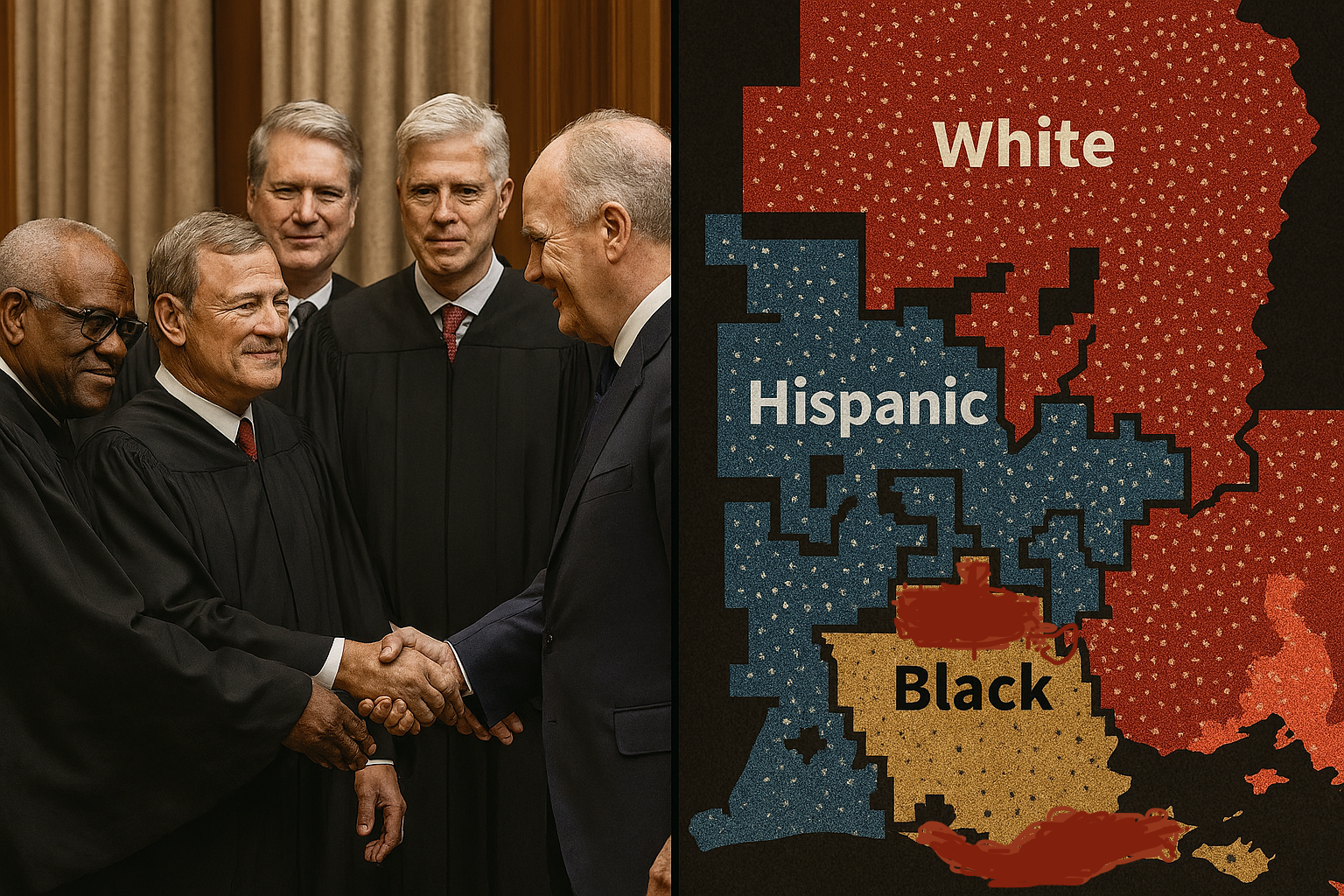
In 2021, the Supreme Court’s decision in Brnovich v. Democratic National Committee gutted Section 2 of the Voting Rights Act, a provision that once protected against racial vote dilution. The ruling made it nearly impossible to challenge laws that disproportionately harm Black voters.
White justices didn’t ban Black voting—they hollowed it out. ADOS can still cast ballots, but those votes are increasingly powerless to shape policy or influence governance. Gerrymandering, voter ID laws, and strategic polling closures ensure that representation is symbolic, not structural.
This is Jim Crow 2.0: a democracy that counts Black votes but never lets them count.
For a breakdown of how these ruling impacts minority voters, see Brennan Center’s analysis.
Representation Without Influence Is a Lie
Despite record turnout in recent elections, ADOS communities remain locked out of decision-making. Their elected officials are often absorbed into party machines that prioritize optics over outcomes. Progressive coalitions celebrate diversity while managing Black decline.
ADOS are visible in elections but invisible in legislation. The ballot box is no longer a gateway to power; it’s a stage for performance.
For data on Black voter turnout vs. policy outcomes, see Pew Research Center’s report.
North Carolina’s latest redistricting plan is widely seen as a strategic move to dilute Black voting power by reshaping districts to favor Republican control and weaken the influence of historically Black communities.
The new congressional map, passed by the Republican-led legislature, targets District 1—a historically Black and Democratic-leaning district—by removing diverse counties and replacing them with whiter, more conservative areas. This shift makes it harder for Black voters to elect candidates of their choice, especially as Rep. Don Davis, one of only three Black members of Congress from North Carolina, is directly affected.
Critics argue this is a form of racial gerrymandering, violating the Voting Rights Act by fragmenting Black voting blocs and spreading them across districts where their influence is minimized. Redistricting trial begins in North Carolina over allegations that GOP-enacted maps erode Black voting power | PBS News Lawsuits from civil rights groups and Black residents claim the maps were engineered to suppress minority representation, while Republican lawmakers insist the changes are purely partisan.
In essence, the redistricting reflects a broader national trend of using map manipulation to entrench dominant culture power, undermining Black political agency and threatening fair representation for communities of color.
Comfort Is a Privilege—Justice Is Not
If Progressives, liberal democrats, and maybe even some republicans in the dominant culture wants justice, it must get uncomfortable.
ADOS were never comfortable, not when they were enslaved, lynched, raped, redlined, or robbed of generational wealth. So why should justice feel good to those who benefited from that suffering?
Reparations will require tax dollars. That means white progressives, “No Kings” supporters, “People of color”, and liberals must fund what they don’t want to pay for. For a breakdown of reparations proposals and cost estimates, see Brookings Institution’s reparations framework and Reparations » The ADOS Advocacy Foundation
ADOS taxpayers already fund wars, foreign aid, and corporate bailouts. They don’t want their money used to build nations abroad while their own community’s collapse. For federal spending breakdowns, see USAspending.gov.
Justice isn’t a vibe, it’s a cost. And We got the ballot box—but not the power or representation.
Identity Politics Was Never Justice Work
For years, ADOS advocates, and members of this organization, warned that lumping Black Americans into the “people of color” category would erase their unique lineage and justice claims. Progressive movements ignored these warnings, opting for symbolic gestures and rainbow coalitions.
Now, as ADOS communities face catastrophic decline, those same leaders refuse accountability. They won’t admit that their strategies failed. They won’t acknowledge that ADOS needs targeted justice and significant representation in government, not generalized diversity.
For a critique of POC frameworks and their impact on Black policy outcomes, see Yvette Carnell’s ADOS Advocacy and The New York Times’ analysis.
In addition, Black leaders representing majority-white districts often face political compromise, forced to dilute ADOS-specific advocacy and agenda plans to maintain cross-racial appeal, while progressive multiculturalism, though well-intentioned, has sidelined ADOS needs in favor of broader coalitions, contributing to stagnation and continued generational decline.
In cities like Pittsburgh, Minneapolis, Chicago, and Philadelphia, Black elected officials often represent districts where white voters dominate turnout and donor influence.
These dynamic pressures leaders to adopt universalist rhetoric, social trends, and non-Black agendas, avoiding reparations, targeted investment, protections, or ADOS-centered policy for fear of alienating their base.
Meanwhile, rainbow coalitions and multicultural frameworks, celebrated by progressives and Democratic socialist, have prioritized immigration, LGBTQ+ rights, and global humanitarian causes, while ADOS communities remain trapped in cycles of eviction, severe poverty, poverty crimes, homelessness, unemployment, lack of opportunity, food insecurity, and wage stagnation.
What our data has shown here at ground zero in Braddock, PA and through the greater Pittsburgh region, is that this performative type of politics has replaced tangible solutions with hashtags and symbolic gestures, rewarding the least in need for their votes, while leaving ADOS families to crowdfund groceries while watching billions flow to non-ADOS initiatives. Performative Politics: When Words Replace Action – The Braddock Inclusion Project
Pew Research shows that while Black Americans overwhelmingly believe voting is key to equality, many express deep skepticisms about whether current leadership and allyship strategies are truly advancing their material conditions. Black Americans’ views on political strategies, leadership and allyship for achieving equality | Pew Research Center
The result: Since the end of the civil rights era there’s been generations of compromised representation and a policy landscape that praises diversity, campaign funding, and votes while neglecting the dire situation facing descendants of American slavery, their humanity, basic survival, and decreasing representation in government.
The Constitution Never Protected ADOS
Many Black leaders are out fighting to “save the Constitution,” but save it for whom?
The Constitution didn’t stop slavery. It didn’t prevent lynching. It didn’t guarantee wealth, opportunity, protections, safety, or dignity. It was never enforced for ADOS. It was a document of exclusion dressed in the language of liberty.
We got the ballot box—but not the power. That’s the refrain. That’s the truth America must face.
For historical context, see Thurgood Marshall’s Bicentennial Speech, where he critiques the Constitution’s original intent
The New Normal: Racism Without Consequences
If ADOS doesn’t adjust to this moment, the new normal will be racism without consequences. A system where Black suffering is normalized, Black votes are neutralized, and Black futures are sacrificed for national comfort.
This isn’t just a political crisis—it’s a moral collapse.
For data on racial disparities in wealth, health, and incarceration, see National Equity Atlas and Economic Policy Institute.
Black communities are being systematically positioned as the first to enter the “useless class”, a term coined to describe those rendered economically obsolete, not because of lack of talent, but because of deliberate exclusion from power, wealth, opportunity, and political representation.
Despite centuries of labor and sacrifice, Black American Descendants of Slavery (ADOS) hold just 11 cents for every dollar of white household wealth and receive less than 2% of venture capital funding.
Their voting blocs are fragmented through redistricting and gentrification, stripping them of political leverage. Leadership is compromised, many congressional and state Black officials represent majority-white districts, forced to mute ADOS-specific demands to retain office and social status.
The result is a leadership vacuum where symbolism replaces strategy, and bare minimal survival is mistaken for progress. As automation and AI threaten low-wage sectors, ADOS workers, already overrepresented in precarious jobs, face mass displacement without safety nets.
As we have said before, without radical intervention, ADOS will be the first group deemed “excess” by an economy that never intended to include them. This isn’t just neglect, it’s engineered obsolescence. The Roots of Decline: A Legacy of Structural Harm – The Braddock Inclusion Project
The Path Forward: Radical Accountability
ADOS communities must urgently move with precision, rage, and strategy because survival is no longer guaranteed, and dignity will not be granted without a fight.
Solutions might include working to build independent political infrastructure, new committed allyships withing the dominate culture, local PACs, voter education hubs, and watchdog networks, to build united voting blocs, reclaim representation and expose compromised leadership.
Newley cultivated Leadership must demand targeted reparative policies, not diversity platitudes including land trusts, guaranteed income pilots, and federal contracts earmarked for ADOS-led entities. They must weaponize data: track philanthropic redlining, map food deserts, and publish impact reports that shame institutions into action.
Collectively they must work to create self-sustaining economic enclaves comprised of co-ops, credit unions, landbanks, and supply chains rooted in ADOS labor and ownership. We must train a new class of radical organizers, leaders, and technologists, capable of defending our communities from AI displacement and digital erasure.
And we must mobilize through iconic campaigns that expose status threat, Black misleadership, and performative inclusion because narrative warfare is survival.
The Braddock Inclusion Project is already modeling this resistance: delivering food as protest, securing land for infrastructure development, metrics as indictment, and storytelling as armor. The time for symbolism is over. We are the wreckage. We are the architects.
Justice will not come through comfort. It will come through reckoning.
Reparations must be funded. ADOS must be centered—not absorbed. Black Misleadership must be replaced with radical accountability. Symbolic inclusion must give way to structural change.
Our message to ADOS and those in America truly invested in justice, is not just critique; it’s an urgent call to action. We got the ballot box—but not the power or representation that comes with it. In fact, it’s slipping away right before our very eyes.
Leave a Reply