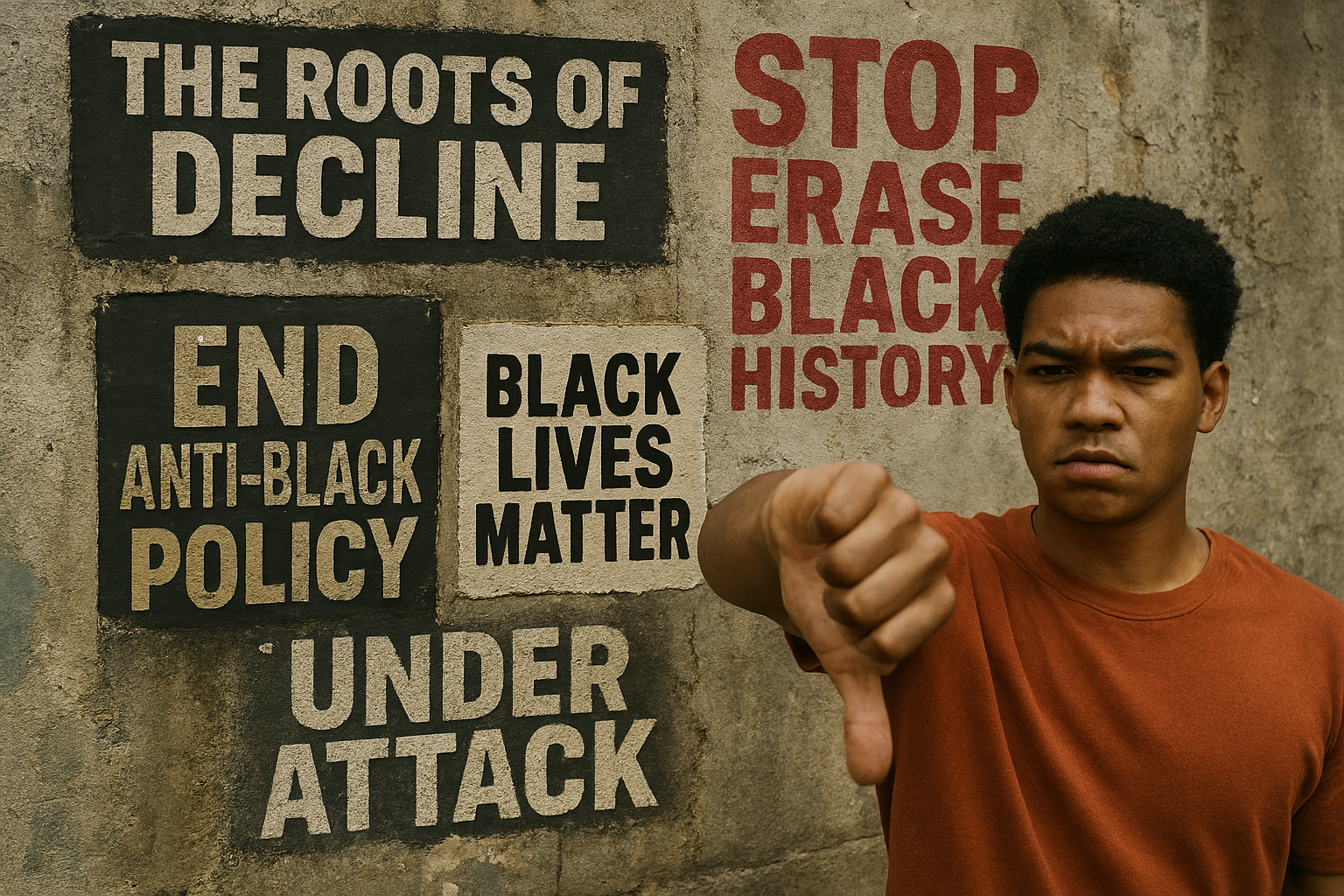
The Roots of Decline: Why the Quality of Life for Black American Descendants of Slavery Is Rapidly Deteriorating
By any honest measure, the quality of life for Black American Descendants of Slavery (ADOS) is in crisis. Despite centuries of resilience, the forces undermining ADOS communities have evolved into a sophisticated matrix of economic sabotage, cultural erasure, and political neglect.
This deterioration is not accidental, it is the result of deliberate policy choices, systemic inertia, and a leadership vacuum that has failed to confront the scale of the emergency.
The historical trauma of slavery and Jim Crow laid the foundation for today’s disparities. Families whose ancestors were enslaved until the Civil War have significantly lower education, income, and wealth than those whose ancestors were free before emancipation. This is not just a historical footnote—it’s a living legacy of exclusion.
Black families concentrated in the Deep South under Jim Crow laws were denied access to wealth-building programs like the GI Bill and FHA loans. Today, the median Black household holds just 13 cents for every dollar of white household wealth.
These disparities are not isolated; they are the roots of decline that continue to shape every aspect of ADOS life.
Systemic Racism Across Every Life Domain
From birth to death, Black Americans face systemic disadvantages that are immune to decades of sacrifices, human/civil rights movements, and reform efforts.
Black women are 3–4x more likely to die from pregnancy-related causes than whites. Black students are less likely to attend high-quality schools or earn degrees. Black household wealth is 6x lower than white households. Black households are 2.5x more likely to struggle with food access. Black graduates owe $7,000 more on average than white peers.
These disparities are not just statistical; they are lived realities that shape every aspect of ADOS life.
Land Theft and Economic Dispossession
Black Americans lost an estimated 80% of the land they owned after the Civil War due to heirs’ property laws, legal loopholes, and systemic theft. Land ownership is a cornerstone of generational wealth, and its loss has had devastating ripple effects.
Families like Saul Blair’s in Georgia have spent decades trying to reclaim land purchased by formerly enslaved ancestors. Without clear titles or legal protections, Black landowners are vulnerable to exploitation, foreclosure, and ongoing displacement.
Land theft remains one of the most devastating and underreported forms of economic sabotage. This loss of land, and the generational wealth it could have produced, continues to haunt ADOS communities.
Black-owned businesses receive less than 2% of venture capital funding. Federal disinvestment in Black neighborhoods persists, even as white nationalist violence rises unchecked. Without an economic base, no leadership can be effective. The roots of decline are measured in eviction notices, shuttered storefronts, and denied loans.
The Roots of Decline: Erasure by Policy, Silence by Design
The deterioration of life for Black American Descendants of Slavery (ADOS) is no longer just a consequence of neglect, it is the result of active erasure. Under the current administration, a sweeping campaign to dismantle diversity, equity, and inclusion (DEI) programs has taken hold, targeting every federal agency, educational institution, and cultural archive that affirms Black history and identity.
In January 2025, the White House issued a directive to terminate all DEI and environmental justice programs across the federal government. This includes eliminating Chief Diversity Officer positions, canceling equity action plans, and revoking DEI-related grants and contracts. The order mandates that federal employment practices must “not under any circumstances consider DEI or DEIA factors,” effectively erasing decades of progress toward racial equity.
This is not just bureaucratic reshuffling—it is a calculated rollback of civil rights infrastructure. The Congressional Black Caucus Foundation warns that these executive actions pose “serious threats to the progress and well-being of Black communities” and risk exacerbating systemic inequities.
Meanwhile, cultural erasure is unfolding in real time. Over 300 books by Black authors discussing race, gender, and identity were banned in the past year alone. Federal websites have removed references to Harriet Tubman, Medgar Evers, and Jackie Robinson. Military training materials featuring the Tuskegee Airmen have been purged. Even Juneteenth, the federal holiday commemorating the end of slavery, has been undermined by executive orders that accuse Black history museums of promoting “divisive ideology”.
This is the roots of decline in full bloom: a society that not only fails to invest in Black futures but actively erases Black pasts.
The Crisis of Black Leadership in the Age of Erasure
As systemic challenges mount, the crisis in Black leadership has become a central accelerant of decline. Dr. Amos Wilson’s prophetic warning, that “leadership without power is mere performance”, rings truer than ever.
When Leadership Enables Erasure
Perhaps most devastating is the role of ineffective Black leadership in enabling this decline. As outlined in the Erasure Protocol, many Black elected officials have become complicit in symbolic inclusion while resisting substantive redistribution. They are celebrated for their presence but punished for their truth. When they demand reparative policies, they are redirected to universal “uplift of all” programs that never reach ADOS communities.
This leadership vacuum allows the erasure protocol to flourish, unchecked, unchallenged, and unacknowledged.
In 2025, Black leaders are navigating a minefield of tokenism, economic sabotage, and institutional betrayal.
Only 1.6% of Fortune 500 CEOs are Black. DEI programs are being dismantled across sectors, with federal agencies rolling back equity initiatives. Over 300 books by Black authors were banned in 2024 alone.
This leadership crisis is not just symbolic, it is structural. Without authentic, community-rooted leadership, ADOS communities are left vulnerable to erasure, manipulation, and ongoing neglect. The roots of decline deepen when leadership becomes assimilationist rather than transformational.
AI, Automation, and the Rise of Digital Displacement
The rapid rise of artificial intelligence, automation, and robotics is reshaping the American workforce and Black workers are disproportionately at risk. According to McKinsey, Black Americans are overrepresented in four of the top five occupations most vulnerable to automation: office support, production work, food services, and mechanical repair.
24% of Black workers are in jobs with over 75% automation potential. Generative AI could widen the racial wealth gap by $43 billion annually if deployed without equity safeguards.
While AI offers potential for innovation, it also threatens to accelerate the roots of decline by displacing Black workers from already precarious positions. Without targeted reskilling and inclusive tech policy, the digital revolution will become a new frontier of exclusion.
The Migrant Explosion and the Politics of Replacement
As ADOS communities face erasure, a demographic shift is accelerating their displacement. Since 1980, over 500,000 Black residents have been pushed out of historically Black neighborhoods due to gentrification and policy-driven migration patterns. Cities like Los Angeles, Washington, and Atlanta have seen entire Black communities replaced by Latino, Asian, and white residents. In Watts, California, a neighborhood once two-thirds Black is now nearly 80% Latino.
This transformation is often framed as progress but for ADOS, it feels like disappearance. The influx of migrant populations, while deserving of dignity and rights, has been weaponized to dilute Black political power and redirect resources away from the communities most harmed by American history.
The Migrant Population Explosion and Interracial Displacement
The demographic landscape of Black America is shifting rapidly. Black immigrants now make up 20% of the U.S. Black population, and their numbers are projected to grow significantly. While diversity is often celebrated, the influx of foreign-born Black populations has complex implications for ADOS communities.
In cities like Minneapolis, native-born Black residents have declined from 70% to 39% in some neighborhoods, replaced by foreign-born populations and white residents. This shift has led to intra-racial competition for housing, jobs, and political representation, often sidelining ADOS voices in favor of more “palatable” and politically convenient immigrant narratives.
The roots of decline are further entangled when ADOS communities are displaced not only by gentrification and redistricting but by demographic shifts that dilute their political and cultural influence.
Reclaiming Power and Possibility
The deterioration of ADOS quality of life is reversible. But only if we confront the roots of decline with urgency, vision, and unapologetic truth.
This in part requires reparative economic policies rooted in historical accountability. Equity audits across federal, state, and corporate institutions. Massive “targeted” investment in Black-led education, healthcare, housing, industry, tech, and land reclamation.
Most importantly the cultivation of new leadership that centers ADOS voices and demands systemic transformation must be prioritized. The age of Black erasure is here—but so is the opportunity for radical restoration. The question is not whether we can reverse the decline. The question is whether we will.
Leave a Reply