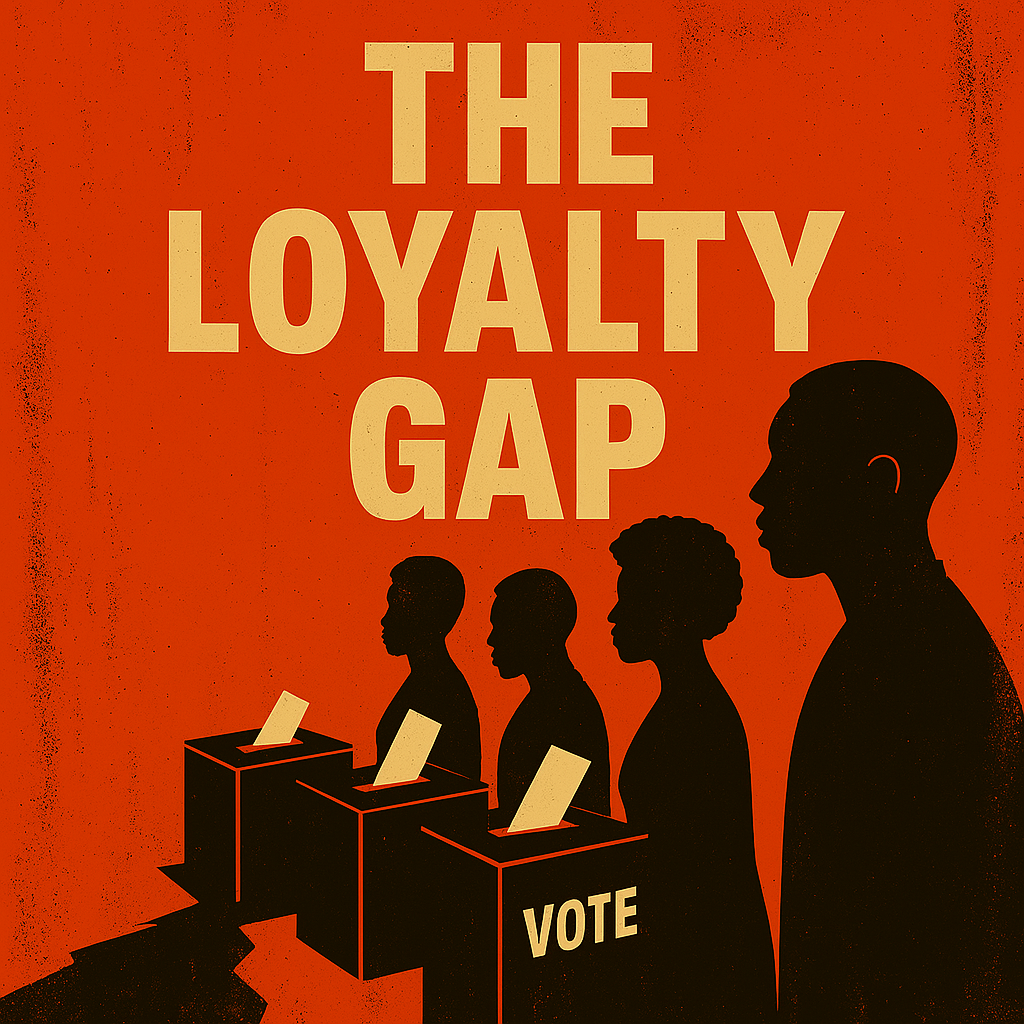
The Loyalty Gap is not just political, it’s generational theft.
For over half a century, Black Americans, especially those descended from U.S. chattel slavery, have been the most loyal voting bloc in the Democratic Party. In 2020, 90% of Black voters cast their ballots for Joe Biden. Yet despite this unwavering support, the material conditions of Black life remain unchanged. In cases, they have worsened.
Drawing on recent legislative efforts, economic data, health, and education statistics, we argue that symbolic gestures have supplanted structural change. We believe that targeted legislation, policies, and a lineage-based reparations framework remains the only paths to authentic justice.
Over the past 16 years, the Democratic Party has held the White House for 12 and controlled both chambers of Congress for four. At various points, they have also held majorities in both chambers of Congress.
During this period, the party has positioned itself as the political home for Black Americans, particularly those whose lineage traces back to American chattel slavery.
Yet, for the 40 million Black Americans, especially the descendants of enslaved Africans, the material conditions of life remain unchanged or have worsened. Where is the transformative change? Where is the targeted repair for the communities that have endured the most of America’s original sin? What has the loyalty gap produced?
We’ve seen the pageantry; Juneteenth holidays, diversity task forces, symbolic appointments. But symbolism is not justice. Visibility is not viability. And representation without targeted polices, protective laws, and reparations is just another form of neglect. It has sustained the loyalty gap.
Let’s look at some of the facts:
The median wealth of white households is $250,400. For Black households, it’s just $27,100—a staggering 9-to-1 gap (Pew Research).
Black women are nearly three times more likely to die from pregnancy-related causes than white women (KFF).
Black Americans make up 13% of the U.S. population but nearly 39% of the incarcerated population (Prison Policy Initiative).
Even Black college graduates have less wealth than white high school dropouts (Brookings).
These are not just statistics. They are the lived realities of millions of Black Americans—realities that persist despite decades of Democratic control and campaign promises.
So why hasn’t more been done?
Because the Democratic Party and its’ Progressive wing has mastered the art of performative politics. It offers gestures instead of guarantees. It assumes Black support is automatic, not earned. And too many Black elected officials have become gatekeepers of the status quo—more invested in preserving their positions than transforming our conditions. They’ve become master of maintaining and managing the loyalty gap.
Political Rhetoric vs. Policy Reality
While Democratic leadership has made symbolic overtures toward racial justice, including Juneteenth recognition and diversity initiatives, substantive reparative policies have stalled or been pushed to the bottom of the priority list due to more convenient political issues.
The reintroduction of the “Reparations Now” resolution by Rep. Summer Lee in 2025, following earlier efforts by Rep. Cori Bush, calls for trillions in reparations to address the legacy of slavery, Jim Crow, and systemic racism. Yet, despite growing grassroots support, no federal reparations bill has passed.
At the state level, progress has been uneven. Washington State recently approved a resolution to establish a reparations commission, while California has advanced lineage-based proposals that may face legal challenges under the Supreme Court’s affirmative action rulings.
These efforts, though significant, remain exploratory and lack the funding and enforcement mechanisms necessary for transformative impact.
The Racial Wealth Gap: A Legacy Unaddressed
One of the most devastating consequences of the loyalty gap is the ever widening of the wealth gap. The racial wealth gap remains the most glaring indicator of systemic failure. As of 2022:
The median wealth of white households was $285,000, compared to just $44,890 for Black households. For every $100 in white wealth, Black households held only $15. In New Jersey, the median net worth for Black families is $20,000, compared to $662,500 for white families.
These disparities are not the result of individual behavior but of centuries of exclusion from wealth-building opportunities. From the denial of “40 acres and a mule” to redlining and discriminatory GI Bill implementation. Reparations scholars estimate the cost of slavery and post-slavery discrimination to range from $12 trillion to over $35 trillion, depending on the methodology.
Mass Incarceration: The New Plantation
Black Americans comprise 40% of the incarcerated population despite being only 13% of the U.S. population. This overrepresentation is rooted in the post-slavery criminalization of Black life, from Black Codes to the War on Drugs. The 13th Amendment’s exception clause has enabled the continuation of forced labor through prison systems, disproportionately impacting ADOS communities.
Education: Separate and Unequal
Despite the promises of Brown v. Board of Education, educational disparities remain stark:
Black students are less likely to attend schools with advanced coursework or experienced teachers. Only 7% of Black 12th graders scored proficient in math in 2015, compared to 32% of white students. Black students are suspended at rates four times higher than white students, contributing to the school-to-prison pipeline.
These disparities are compounded by underfunded schools in predominantly Black districts and biased disciplinary practices.
Health Disparities: A Matter of Life and Death
Black Americans face higher rates of chronic illness, maternal mortality, and premature death:
Life expectancy for Black Americans is 72.8 years, five years less than white Americans. Black infants die at more than twice the rate of white infants. Black women are nearly three times more likely to die from pregnancy-related causes. These outcomes are not merely the result of poverty but of systemic racism in health care access, treatment, and research.
The Case for Lineage-Based Reparations
Closing the generational loyalty gap means demanding policy, not platitudes. The data is unequivocal: race-neutral policies have failed to close the gap. Reparations must be targeted to the specific harms endured by Black American Descendants of Slavery.
This includes direct cash payments and wealth transfers. Land restitution and housing grants. Guaranteed income and debt cancellation. Investments in Black-owned and controlled industries, institutions, healthcare systems, housing markets and education.
Lineage-based policies and reparations are not about exclusion. They are about precision. As California’s task force concluded, race is an imperfect proxy; lineage is the legal and moral basis for redress.
The illusion of progress has masked the reality of stagnation and growing decline. Despite Democratic/Progressive having control over major cities and rhetorical commitments to equity, the material conditions of Black American Descendants of Slavery remain dire.
It is time to move beyond symbolism and toward structural repair. Targeted policies and reparations are not a radical demand; they are a moral imperative and a constitutional necessity. It is past time for political reckoning.
We must stop confusing proximity to power with actual power. We must stop trading our votes for symbolism. And we must stop allowing any party—Democrat, Progressive or Republican—to take our communities for granted.
That means cultivating new leadership that will work towards and demand specific, lineage-based Black agendas. Not “people of color.” Not “underserved communities.” A targeted agenda that addresses the unique harms of slavery, Jim Crow, redlining, mass incarceration, and systemic exclusion from the coming innovation economy.
It means holding elected officials accountable. If they don’t support reparations, targeted investments, and structural reform, they should not get our vote. Period.
It means building independent political infrastructure—supporting local and state-level reparations efforts like those in California and New Jersey, and backing organizations like the ADOS Advocacy Foundation. And it means educating and mobilizing our communities because political literacy is liberation.
We are not powerless. But we are currently being played by performative politicians, year after year.
The time for symbolism and the loyalty gap is over. The time for strategic, unapologetic political engagement is now. If elected officials, Black, white or “people of color”, cannot deliver material and tangible change, they must be replaced.
And until targeted polices are enacted, protective laws established, and the debt is paid, the promise of American democracy remains unfulfilled.
Leave a Reply