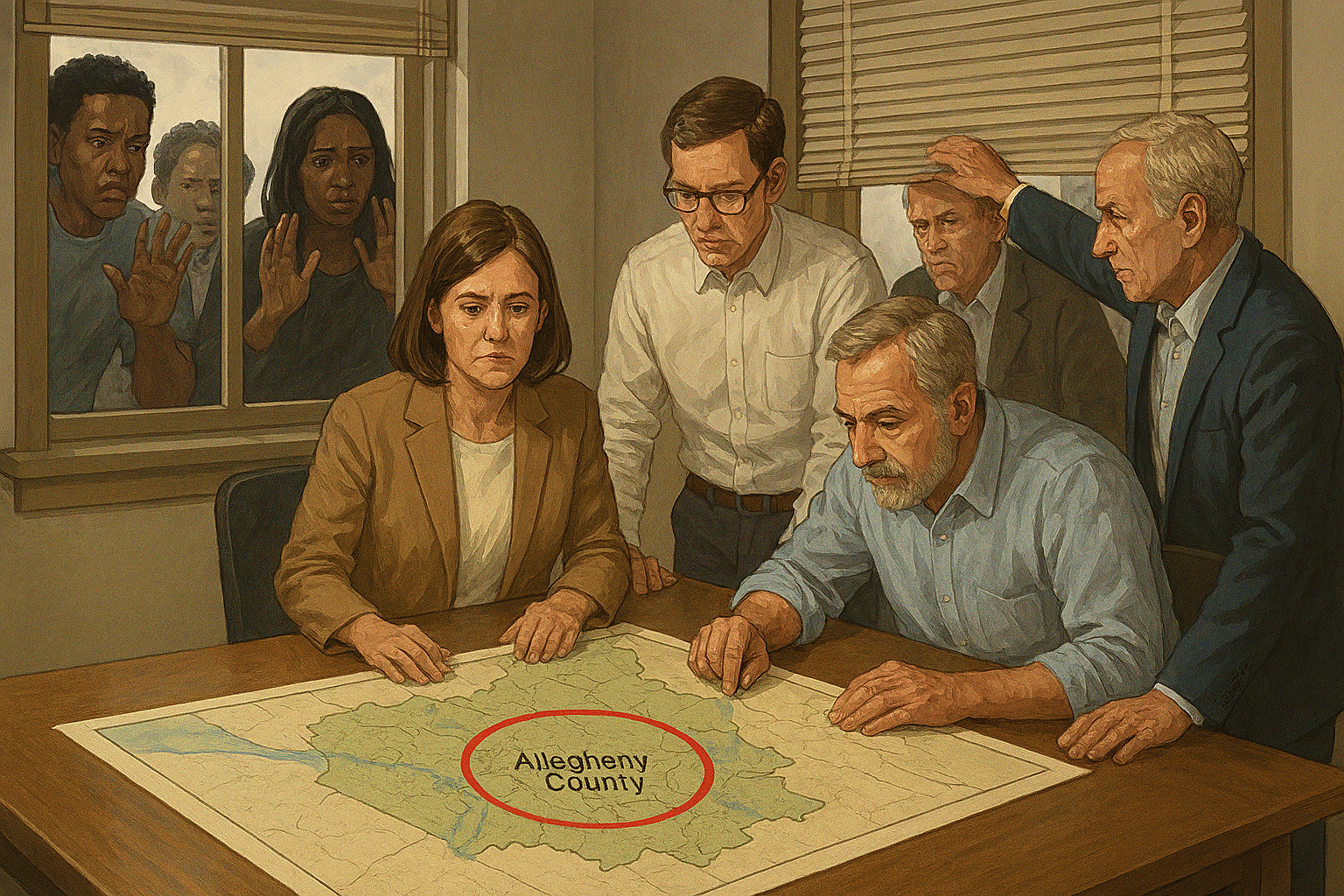
The Clock Is Already Ticking and Allegheny County Wants Your Input. But Who Will Truly Be Heard?
Allegheny County has launched its first comprehensive plan in nearly two decades — a sweeping 25‑year blueprint called Allegheny Forward. Officials insist that “community engagement is at the heart of the process.” They promise public meetings, surveys, listening sessions, and open doors.
But here’s the truth we cannot ignore, The Clock Is Already Ticking, and the same institutions that historically excluded Black voices are now asking for trust while placing the future of our communities in the hands of three white‑led consulting firms.
The Clock Is Already Ticking — and the same institutions that historically excluded Black voices are now asking for trust while placing the future of our communities in the hands of three white‑led consulting firms. According to the county’s own materials, the planning process will be led by the SmithGroup People | SmithGroup , OHM Advisors Leadership Team | OHM Advisors , and Pashek + MTR People – Pashek+MTR .
These firms will shape the data, the priorities, the recommendations, and ultimately the policies that determine what Allegheny County looks like in 2050.
And while the county says you are at the center of the process, real power remains exactly where it has always been, outside the Mon Valley, outside Black neighborhoods, and outside ADOS hands.
The Clock Is Already Ticking — and the Mon Valley Or any Black Community in Allegheny County Cannot Survive Another Cycle of the Regions ongoing “Great Gentrification Renaissance.”
For decades, the Mon Valley has been the testing ground for neglect and Management of Decline leadership.
Braddock’s population has fallen by more than 90% since 1920. Duquesne’s population has dropped by nearly 80%. McKeesport has lost more than half its residents since 1970. In many cases these shifts were due to White Flight. https://www.census.gov
Black homeownership in Allegheny County is stuck at around 30%, compared to 73% for white residents. Black median household income in the county is less than half that of white households. https://ucsur.pitt.edu
Life expectancy in some Mon Valley communities is 10–15 years lower than in wealthier white suburbs. https://www.health.pa.gov
These numbers aren’t abstract. They are the lived reality of Black families in the region who have endured school closures, hospital closures, industrial abandonment, and environmental hazards.
Not to mention high crime rates, high unemployment, displacement, intentional disinvestment, and political neglect.
And now, with a 25‑year plan on the table, the stakes are higher than ever.
But realistically speaking, in a world that’s rapidly transforming before our eyes due to AI, robotics, and automation, can Black folks even survive another 25 years in what is already considered on of the worst regions in America for Black folks to live.
Could that be a part of the 25-year calculation? A plan gentrification plan built around and based on the fact that Black folks might not be around?
One thing is certain, If Black residents do not show up at every meeting, speak up, and stay engaged, this plan will become the next chapter in the region’s ongoing “Great Gentrification Renaissance.”
The Clock Is Already Ticking: And current Leadership Has Already Shown Us What Silence Produces
Let’s be honest, under current leadership, county, municipal, and regional, the situation for ADOS communities has not improved. It has worsened.
Black poverty rates remain the highest in the region. Black unemployment remains double that of white residents. Black youth face the highest rates of school discipline, homelessness, and lowest access to advanced coursework.
Black neighborhoods receive the lowest infrastructure investment, Federal, State, and County funding allocations. Black renters face the highest eviction rates. Due to extreme economic deprivation and low wages, homeownership is out of reach.
These outcomes are not accidents. They are the predictable results of decades of exclusion from decision‑making.
And now, the county is asking for “feedback” while simultaneously empowering consultants who have no lived connection to the Mon Valley, no generational ties to ADOS struggle, and no accountability to the communities most at risk.
The Clock Is Already Ticking and Progressive Cities Are Failing ADOS Communities Most
Across America, cities draped in progressive banners, with Democratic majorities, equity task forces, and Black elected officials, are producing some of the worst outcomes for ADOS residents.
This isn’t just ironic. It’s systemic and rooted in data.
Pittsburgh ranks dead last, 76th out of 76 major cities, for Black economic opportunity, housing access, healthcare outcomes, and representation.
Despite its progressive reputation, Pittsburgh remains one of the most hostile places in America for ADOS to live, survive, and build futures.
Black poverty in Pittsburgh rose in 2024, even as national poverty declined. Over 57,000 residents live below the poverty line, disproportionately Black. Black homeownership remains stagnant, while white homeownership climbs. The Illusion of Progress Masks Black Suffering – The Braddock Inclusion Project
These are not policy oversights. They are engineered outcomes, masked by diversity optics, symbolic leadership, and progressive applause from the least in need communities, industries, institutions, and connected cliques in the region who benefit the most and that are thriving under current leadership.
In cities like Chicago, Oakland, Baltimore, and Philadelphia, all progressive strongholds. These cities all boast equity plans, inclusion panels, and progressive mayors.
But they also host the deepest racial disparities in America, especially for ADOS communities. Racial Equity Index: Summary | National Equity Atlas
The Clock Is Already Ticking and Symbolic Leadership Is Not Liberation
In Pittsburgh, progressive elites have embraced a new generation of Black leadership. They cheer at rallies. They repost equity statements. They celebrate historic elections. But beneath the applause, ADOS communities are sinking deeper into, food insecurity, housing crisis, Homelessness, extreme economic deprivation, extreme poverty and unemployment.
These are not isolated failures. They are the predictable result of performative inclusion without structural change.
Across the country, many people are calling for a dismantling of the current Democratic Party structure — and for ADOS communities, the urgency behind that demand is not theoretical. It is lived. In some of the most progressive‑led regions in America, ADOS residents face the worst quality‑of‑life indicators, the deepest economic deprivation, and the most entrenched racial disparities of any ethnic group in the nation.
Cities celebrated as “progressive strongholds” consistently rank at the bottom for Black well‑being.
Pittsburgh was identified as the worst major city in America for Black residents across economic, health, and educational outcomes. Chicago, Oakland, Philadelphia, Baltimore, and other progressive‑governed cities show the same patterns
These outcomes did not appear overnight. They emerged under leaders who promised equity, progress, and inclusion — yet presided over decades of decline in ADOS neighborhoods.
That is why many argue that ADOS communities must take seriously what is happening nationally, while also challenging, scrutinizing, and replacing local leadership that has failed to deliver material improvements.
If progressive leaders have overseen worsening conditions, widening disparities, and shrinking opportunity, then ADOS residents have every reason to demand accountability and pursue new leadership that reflects their interests, not just their imagery.
At the same time, while progressive factions may be positioning themselves as the loudest challengers to establishment Democrats in Congress, their track record on ADOS‑specific outcomes raises serious questions. Many observers warn that jumping on the progressive bandwagon without examining their local record may not be in the best interests of ADOS communities.
The data shows that symbolic representation, rhetorical solidarity, and progressive branding have not translated into improved material conditions for ADOS families.
That is why many emerging Black opposition groups argue that the most strategic move right now is not to follow national political trends, but to conduct rigorous due diligence on local leadership, who they serve, what they’ve delivered, and whether ADOS communities are better or worse off under their watch.
For ADOS residents living in regions where disparities are widening, opportunities are shrinking, and communities are being displaced, the message is clear!
The time for automatic loyalty, celebrity like worship, and popularity contest voting is over. The time for accountability, research, and strategic political action is now.
The Clock Is Already Ticking and ADOS Must See Through the Illusion
Progressive cities have mastered the art of symbolic progress. Bike lanes in gentrifying neighborhoods, green infrastructure that bypasses or replaces Black blocks.
Tech corridors that displace legacy families. Union jobs that never reach ADOS applicants and “Community engagement” led by white consultants.
The Clock Is Already Ticking and Black Residents Must Flood This Process
Despite the distractions. Despite the daily grind. Despite the survival mode so many of our families live in.
Despite the closed‑door “Social Club” political gatherings where decisions are made before the public ever hears a word. Black folks in our region’s most neglected communities must make sure their voices are herd.
Black residents in the Mon Valley and Allegheny County MUST Attend every public or closed meeting. Demand transparency, insist on inclusive practices, demand a voice in where resources are allocated.
Challenge consultant‑driven narratives when necessary. Push for ADOS‑centered data. Bring youth, elders, and neighbors to meetings. Share the survey with everyone.
Document everything and hold every official accountable, even local elected officials who are handpicked by the consultants to represent the communities.
If we do not show up, the County will move forward without us, and the consequences will be irreversible.
The Clock Is Already Ticking and This Is a Call to emerging ADOS Leadership and residents of all ages.
This moment demands young Black organizers, newly cultivated ADOS leaders, working‑class parents, elders with lived memory and knowledge to show up.
It demands students hungry for change, artists, advocates, and storytellers. Faith leaders and Community builders.
The Mon Valley has produced some of the strongest, most resilient Black people in America. But resilience alone will not protect us from displacement, erasure, political invisibility, and Decline management leadership.
We must transform resilience into resistance and opposition. We must transform everyday survival into strategy. And we must transform pain into power.
If we do not disrupt this cycle, if we do not demand real power, real equity, and real accountability, the next 5 years, let alone 25, will look exactly like the last 100.
The Clock Is Already Ticking and the Next 5-10 Years Will Define the Next 100
If Allegheny County’s 25‑year plan succeeds without Black participation, it will not be a plan for ADOS.
It will be a plan about ADOS, written without us, implemented around us, and used to justify decisions that harm us.
But if we show up loudly, consistently, unapologetically, we can force this process to become something different.
This organization will be pushing a blueprint for justice. A roadmap for equity. A commitment to ADOS survival and dignity. A future where the Mon Valley is not an afterthought, but a priority.
The Clock Has Been Ticking and Now Is the Time
The county has opened the door. But it will not hold it open forever. This is the moment.
This is another fight. This is another line in the sand.
If ADOS communities do not shape this plan for what’s in the best interest for their specific communities, then, as usual, someone else will. And the last 100 years of history have already shown us what that leads to.
The clock is already ticking. And for the future of our communities, the next move belongs to us. Start the process by taking and sharing the survey.
Then begin to organize, make calls to your local community representatives, the consultants, and the county executive, to make sure your voices are heard and included. We can’t wait another 25 years for reparative justice. It must start TODAY!!!
Take the Allegheny Forward survey:
Emerging Themes Survey | Engage Allegheny
Learn more about Valley Forward (Mon Valley regional plan:
Executive Innamorato & Senator Pisciottano Launch Mon Valley Forward – Allegheny County, PA
Leave a Reply