Status Threat: The Unspoken Obstacle to ADOS Justice in America
The Pulse Beneath the Panic
In the shifting landscape of American demographics, one phrase has emerged as a quiet but powerful force shaping policy, philanthropy, and public sentiment: Status Threat. It describes the psychological and political reaction among dominant white Americans to the perceived erosion of their cultural, economic, and political supremacy. For American Descendants of Slavery (ADOS), this reaction is not abstract, it is a direct and escalating threat to justice, autonomy, and survival.
As the U.S. inches toward becoming a majority-minority nation by 2045 (Brookings), the fear among many white Americans is not just about numbers. It is about losing inherited power, unearned privilege, and the ability to define the national narrative. This fear—Status Threat—has already reshaped elections, stalled reparative policies, dismissed civil rights cases, and redirected billions in philanthropic funding away from Black-led movements.
The Anatomy of Status Threat
Political scientists like Michael Tesler and Ashley Jardina have documented how Status Threat drives white Americans to oppose immigration, affirmative action, Civil Rights, and even democracy itself when they feel their dominance slipping (American Political Science Review). In one study, white respondents who were reminded of demographic change were significantly more likely to support authoritarian policies and express racial resentment.
This threat is not passive, it is weaponized:
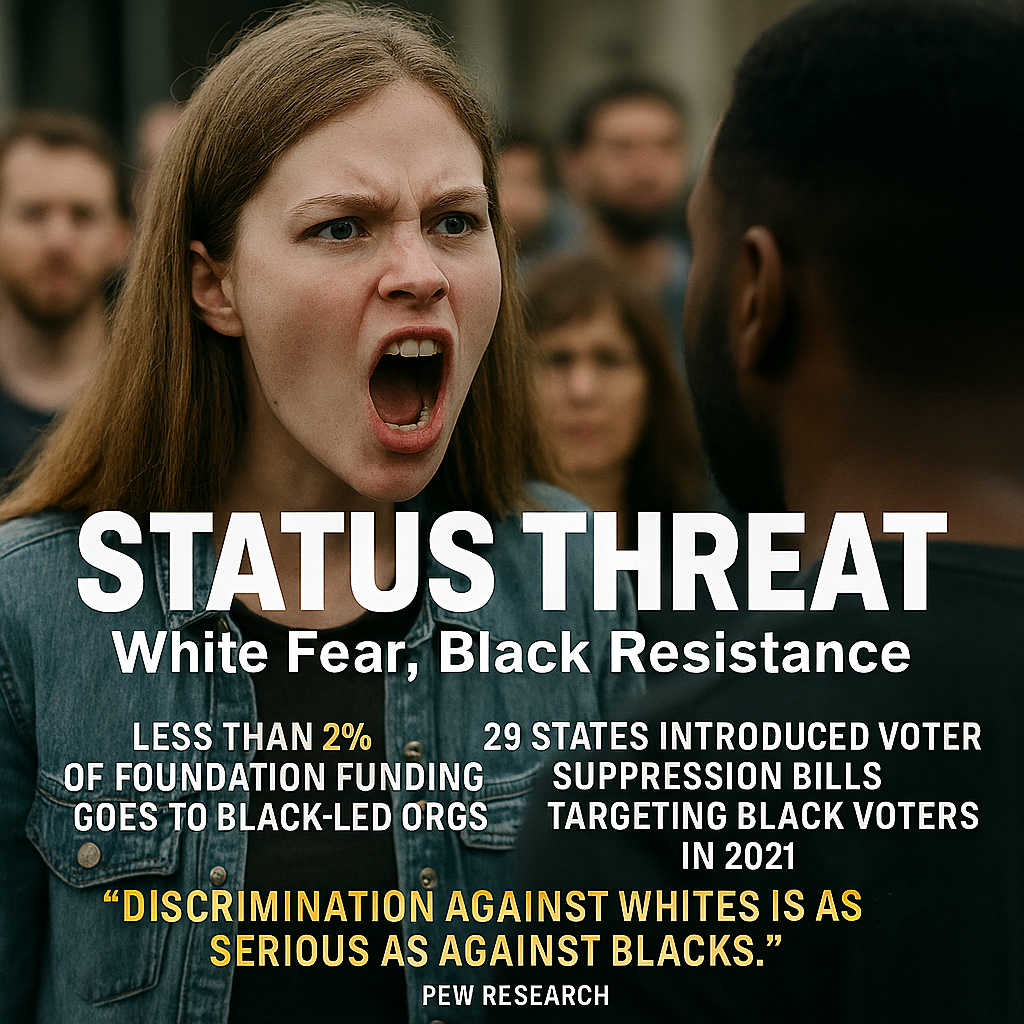
Voter suppression laws disproportionately target Black communities under the guise of “election integrity” (Brennan Center). Philanthropic redlining results in Black-led nonprofits receiving less than 2% of foundation funding, despite being closest to the communities most impacted (ABFE). Narrative policing labels ADOS movements as “divisive” or “radical,” silencing calls for reparations, land access, and leadership development.
Terrifying Fears in Dominant White Culture
The fears driving Status Threat are often cloaked in civility but rooted in deep anxiety. The Fear of reversal, that centuries of racial advantage will be exposed and dismantled.
Fear of accountability, that ADOS demands for reparations and truth-telling will force a reckoning with slavery, Jim Crow, and ongoing exclusion. The fear of irrelevance, that cultural centrality—being the default voice in media, politics, and philanthropy—will be replaced by pluralism.
These fears have real-world expressions. In 2016, a Pew survey found that 55% of white Americans believed “discrimination against whites” was as serious as discrimination against Black people (Pew Research). This inversion of reality is a hallmark of Status Threat, where equity feels like oppression to those accustomed to dominance.
Status Threat in Philanthropy: The Gatekeepers of Contradiction
Over 60% of Americans now admit that racism is widespread, according to Gallup and Pew Research. This public acknowledgment should signal a turning point, a collective readiness to dismantle the systems that uphold racial injustice. But instead, it has exposed a deeper contradiction. The very institutions that profited from slavery, segregation, and systemic exclusion now recognize the harm, yet continue to gatekeep the healing.
The Legacy of Extraction, the Present of Control
Major foundations, universities, and corporations, many of which amassed extraordinary generational wealth through the exploitation of Black labor, have issued statements of solidarity, launched DEI initiatives, and funded racial equity panels. But beneath the surface lies a persistent pattern of philanthropic redlining:
Less than 2% of all foundation funding goes to Black-led organizations, despite their proximity to the communities most impacted (ABFE). Funding is often conditional, short-term, or directed toward white-led intermediaries or “overseers” who dilute radical demands into palatable programming.
ADOS-led movements are routinely excluded from “strategic portfolios” due to being “too political,” “too radical,” or “not scalable”, coded language for rejecting truth-telling and power-building. This is not just neglect. It is Status Threat in institutional form.
The Psychology of Gatekeeping
Status Threat operates on a simple but devastating logic, when dominant groups feel their cultural, economic, or political supremacy is at risk, they respond not with solidarity, but with control. In philanthropy and economic deprivation.
this manifests as narrative policing. ADOS organizations are pressured to soften language, avoid terms like “reparations” or “abolition,” and center “diversity” over liberation. Black leaders are sidelined in favor of “inclusive” coalitions that prioritize comfort and the “Uplift of All” over confrontation.
Resource hoarding in the form that foundations, institutions, and corporations acknowledge racism but fear that resourcing Black autonomy will accelerate their loss of influence. In short, they admit the harm but hoard the healing.
The Cost of Comfort
This contradiction is not benign. It delays justice, distorts movements, and reinforces the very hierarchies it claims to dismantle. ADOS communities are forced to operate on shoestring budgets while white-led organizations receive millions to “study” the same problems Black organizers are already solving. Status Threat ensures that recognition without redistribution becomes another form of violence.
The Compounding Threat of Anti-Blackness in Hispanic Communities
While demographic change is often framed as a monolithic “browning” of America, the reality is more complex and more dangerous for ADOS communities. Anti-Black sentiment within segments of the growing Hispanic population adds another layer to Status Threat.
History and studies show that colorism and anti-Black bias are prevalent in Latinx communities, often mirroring white supremacist structures (Harvard Kennedy School). In cities like Miami and Los Angeles, Black residents report discrimination not only from white institutions but from non-Black immigrant groups competing for resources, visibility and a higher standing in the American hierarchy.
This dynamic creates a triangulated oppression where ADOS communities are marginalized by white status-threat reactions and simultaneously erased or vilified by non-Black groups seeking proximity to whiteness. The result is a fractured coalition, where Black liberation is sidelined in favor of “diversity” that often excludes Black leadership and entire ADOS communities.
Historical Echoes and Present-Day Consequences
Status Threat is not new. It echoes the post-Reconstruction backlash, the rise of Jim Crow, and the resistance to the Civil Rights Movement. Each time Black Americans have pushed for justice, dominant white culture, and now growing “People of Color” groups, has responded with fear, suppression, and narrative control.
Today, the consequences are dire. ADOS-led organizations struggle to scale due to philanthropic bias and performative inclusion. Black Misleadership gatekeepers are installed to pacify radical demands, often chosen for their palatability rather than their proximity to the people.
Policy sabotage in Reparations, housing justice, and food sovereignty is stalled or diluted by white-led institutions claiming to “lead” racial equity.
Naming the Wreckage, Building the Future
To confront Status Threat, we must name it, not as a psychological quirk, but as a systemic force undermining Black justice. ADOS communities are not asking for permission, they must work like never before claim authentic power, visibility, and truth.
But without a reckoning with Status Threat and building new white allyships, even the most visionary movements risk being buried under the weight of white fear. This is not just a demographic moment. It is a moral one. And the question is not whether white America fears change. It’s whether ADOS communities will be allowed to lead or help facilitate that change at this dire point in American history.
Leave a Reply