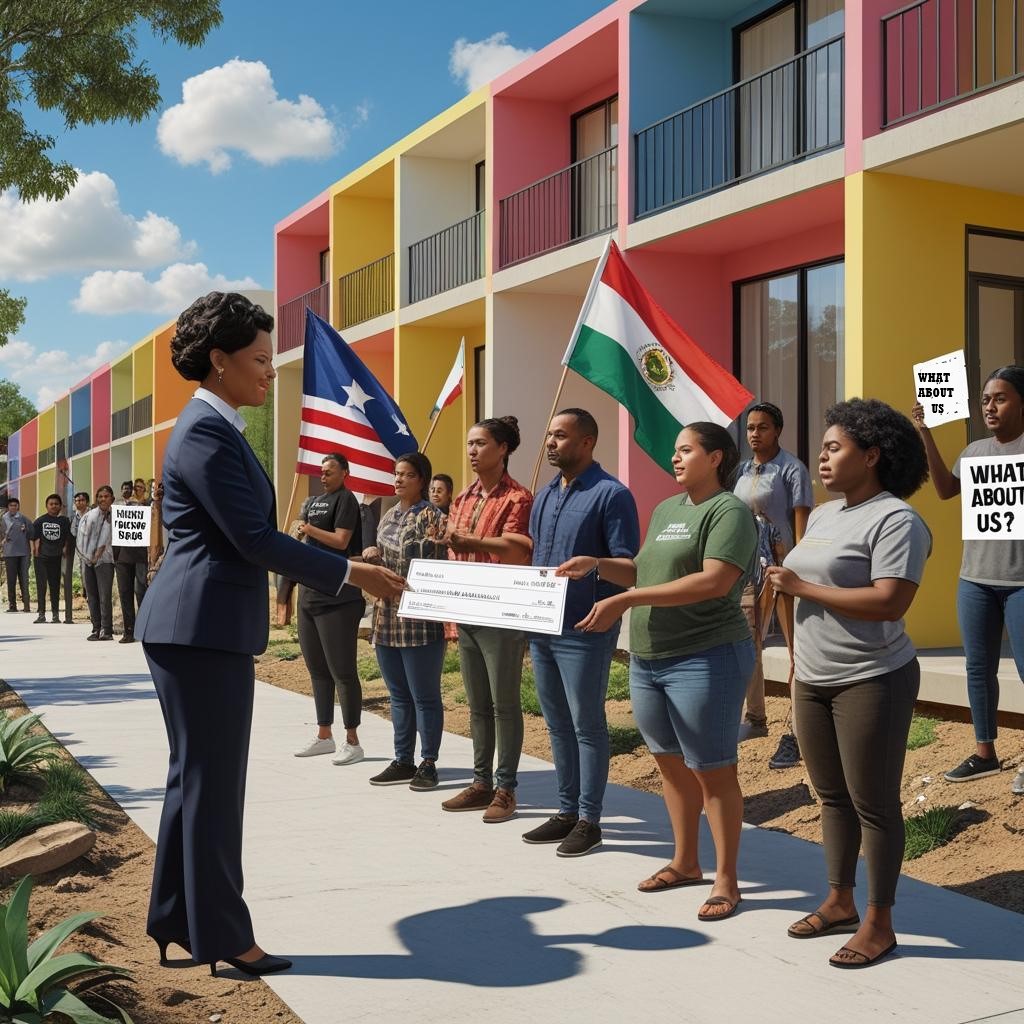
No More Sacrifices for Symbolism: Reclaiming ADOS Power in the Wake of America’s Migrant Shift
For the first time in half a century, the U.S. migrant population is declining. This demographic shift is more than a statistical anomaly; it’s a political reckoning.
For ADOS (American Descendants of Slavery) communities, it presents a rare and urgent opportunity to confront decades of neglect, misleadership, and symbolic politics that have traded Black suffering for proximity to power.
No More Sacrifices for Symbolism. That must be one of the rallying cries for a new generation of Black liberation-minded leaders, those who refuse to be props in someone else’s narrative and instead demand tangible, life-sustaining change for the communities that built this nation.
The Migrant Decline: A Window of Reprioritization
According to U.S. Census Bureau data, the foreign-born population in the United States has seen its first significant decline in over 50 years. While mainstream narratives focus on economic implications or humanitarian concerns, few are asking What does this mean for ADOS communities who’ve long been sidelined in favor of migrant–centered policy, reallocated funding, and philanthropy?
In cities like Los Angeles, Chicago, and New York, migrant influxes have strained housing, education, and healthcare systems, often displacing Black residents or redirecting resources away from them. Brookings Institution highlights how immigration has reshaped urban demographics, often to the detriment of legacy Black populations.
Federal and state funding for migrant services has ballooned, while ADOS communities remain underfunded, politically neglected and over-policed. Migration Policy Institute notes the imbalance in policy attention and resource allocation.
This shift demands recalibration. No More Sacrifices for Symbolism. It’s time to redirect attention and investment toward the communities that have endured centuries of systemic exclusion.
The Cost of Imaginary Solidarity
For decades, Black political leadership has leaned into a narrative of “Black-Brown unity,” often elevating migrant causes while ignoring the material suffering of ADOS communities. This performative solidarity has come at a steep cost.
Migrant resettlement programs have contributed to gentrification and pushed Black families out of legacy neighborhoods. Urban Institute research shows how housing pressures disproportionately affect Black renters.
Migrants, often exploited for cheap labor, have undercut wages and job access for Black workers, especially in construction, agriculture, and service sectors. Center for Immigration Studies details how immigration has negatively impacted Black employment.
ESL and migrant-focused programs have diverted attention and funding from underperforming schools in Black neighborhoods. Education Week explores how immigration policy reshapes school priorities.
These are not theoretical harms. They are lived realities. And they’ve been ignored by leaders more interested in optics than outcomes, including current Black leadership.
The Failure of Black Misleadership. No More Sacrifices for Symbolism.
The crisis isn’t just external, it’s internal. Black leadership has failed to deliver for ADOS communities, choosing symbolic wins over structural change.
Despite $1.8 trillion in annual Black spending, ADOS communities own few institutions or industries. Leadership has failed to build banks, schools, or land trusts.
Deferred hope and repeated betrayal have led to emotional exhaustion, anxiety, and depression across Black America. Black Westchester outlines the psychological toll of failed leadership.
Voter turnout in Black communities remains low, not from apathy, but from rational skepticism. People see stagnation, decline and know the slogans won’t save them. Pew Research shows declining trust in political institutions among Black voters.
It is one of the most painful paradoxes in modern Black political life, a Black elected official, draped in the language of representation, holds power in a majority-white district where white communities flourish while the Black neighborhoods they claim to represent rot from systemic neglect.
These leaders, often shielded by white liberal voters, Elites, and the donor class, secure State, Federal and other funding that never touches the soil of Black suffering. They speak at diversity panels and migrant rallies while their own people die in food deserts, failing educational structures, underfunded clinics, over-policed and crime infested streets.
Removing them is no easy feat because they are not accountable to the communities they resemble, but to the ones that elected them for comfort and status quo, not transformative change.
For new, liberation-minded Black leadership to rise, it will take a radical coalition-building effort, forging trust with poor, collage age, and working-class white residents who also feel abandoned, naming shared economic wounds without erasing racial truth, and building a movement that exposes neglect as a bipartisan and human betrayal.
It means knocking on doors in urban trailer parks, suburbs, college dorms, and housing projects alike, refusing respectability politics, and showing up with receipts, not rhetoric. The work is uphill, but the stakes are generational. Because if we don’t reclaim these seats, they will continue to be occupied by those who weaponize our pain for proximity to power.
Global Optics, Local Abandonment: The Cost of Misaligned Priorities
While many Black leaders have championed causes related to immigration, foreign affairs, and “selective outrage” global racial justice, a growing number of scholars, historians, grassroots organizers and community members argue that these efforts often come at the expense of addressing the ongoing systemic genocide facing Black Americans, particularly in historically excluded, economically devastated communities.
Data Snapshot: Systemic Harm at Home
Black Americans are incarcerated at nearly 5 times the rate of white Americans, despite similar rates of offense. Black maternal mortality is 2.6 times higher than that of white women, with preventable deaths concentrated in under-resourced areas.
In cities like Pittsburgh, Black residents face a 20-year life expectancy gap compared to white counterparts just miles away. Over 50% of Black children in urban centers live below the poverty line, while federal and philanthropic funding continues to prioritize refugee resettlement and global aid.
These statistics are not just disparities, they are symptoms of a slow, deliberate erasure. As early as 1951, Black leaders like Paul Robeson and William Patterson submitted the petition We Charge Genocide to the United Nations, accusing the U.S. government of crimes against Black people.
That petition remains relevant today, as structural violence persists through housing, policing, healthcare, and education.
Read the full historical petition on BlackPast.org
Explore the framework of Black genocide on Wikipedia
Foreign Affairs vs. Domestic Crisis
Recent studies show that Black leaders in foreign policy and immigration advocacy often operate within institutions that reward global engagement while sidelining domestic accountability.
For example, the Journal of Social Equity and Public Administration reveals that Black diplomats and foreign policy leaders are often tokenized within a “racialized bureaucracy” that values symbolic diversity over systemic reform.
The Vera Institute highlights how Black immigrants face disproportionate detention and deportation, yet the broader immigrant rights movement has historically neglected anti-Blackness within its own ranks.
Meanwhile, domestic Black communities continue to suffer from underinvestment, political neglect, redlining, and foundation neglect, issues rarely addressed in the same urgency as global refugee crises, foreign aid packages or protecting the rights of new arrivals.
The Double Bind of Black Immigrants
Even within immigration discourse, Black migrants from Africa and the Caribbean face harsher treatment than other groups.
A 2025 study found that Black migrants are disproportionately criminalized, denied asylum, and face systemic bias in immigration courts. Black asylum seekers from countries like Mauritania and Cameroon report being denied basic due process, with judges showing ignorance or hostility toward their cases.
This reveals a painful irony; while Black leaders advocate for immigration reform, Black foreign immigrants themselves are often excluded from protections and sometimes face the same systemic violence as Black Americans.
Symbolism Is Not Solidarity
The prioritization of global optics over local liberation is not just a strategic misstep, it’s a betrayal. Black leadership must be measured not by its presence in international forums, but by its impact in communities like Braddock, Flint, Jackson, and East St. Louis.
Until the systemic genocide of Black Americans is treated with the same urgency as foreign affairs, new arrivals, and the Epstein files, we will remain trapped in a cycle of symbolic gestures and sacrificed lives.
No More Sacrifices for Symbolism. No More Abandonment in the Name of Optics. We must name this betrayal and replace it with radical accountability.
A Blueprint for Liberation-Minded Leadership
Emerging leaders must reject the old playbook and Center ADOS First and foremost. New leadership must prioritize the communities most harmed by systemic neglect. This isn’t exclusion, it’s precision. ADOS Advocacy Foundation offers frameworks for lineage-based policy.
No more speeches. No more panels. Measure success by housing secured, jobs created, Industries, educational, healthcare systems developed, land reclaimed and lives improved. PolicyLink provides tools for equity-based impact measurement.
Reclaim Narrative Control
Stop allowing others to define Blackness through proximity to whiteness or immigrant identity. ADOS lineage is not negotiable, it’s foundational. EJAS Journal explores the boundaries of Black identity and the ADOS movement.
Build Infrastructure, Not Just Influence
Invest in transportation, food systems, education, and media. Liberation is logistical. Black Farmer Fund and Black Futures Lab are leading examples.
Lead with Urgency and Dignity
Speak truth, even when it’s uncomfortable. Refuse to trade Black pain for political access. Rockwood Leadership Institute outlines the traits of liberated Black leadership.
Again, We Are the Wreckage and the Architects
This moment is not just a demographic shift; it’s a moral one. The migrant decline is a signal. It’s time to stop sacrificing ADOS communities for symbolism and start building a future rooted in truth, autonomy, and power.
No More Sacrifices for Symbolism. Let this be the refrain that echoes through every campaign, every grant proposal, every town hall, and every movement. We are the wreckage. We are architects. And we will no longer allow ourselves to be erased.
Leave a Reply