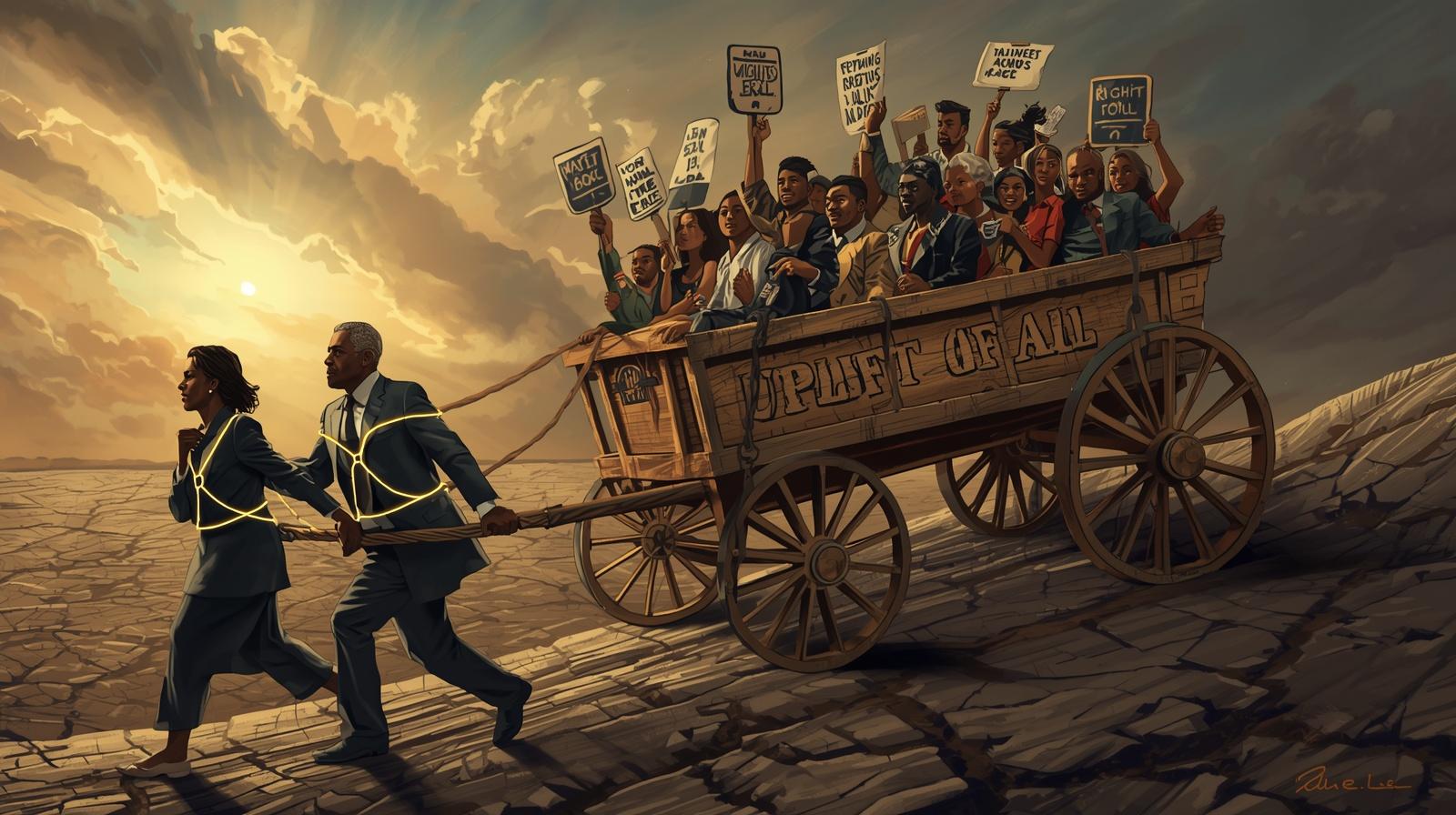
THE INHERITED COLLAPSE: Why America’s Foundational Black Communities Are Still Waiting for Repair
There is a phrase that captures the lived reality of millions of Black Americans whose lineage traces directly to U.S. slavery—a phrase that explains the stagnation, the decline, and the political abandonment that has defined their experience across generations. That phrase is The Inherited Collapse.
It is not a metaphor. It is a measurable, data‑driven description of what happens when a people inherit not wealth, but the accumulated damage of centuries of extraction, exclusion, and state‑sanctioned dispossession.
And it is the only honest framework for understanding why, in 2026, the communities built by American Descendants of Slavery (ADOS) remain the most economically deprived, politically neglected, and structurally abandoned group in the country.
We hope to lay out the fundamental evidence, the mechanisms, and the path forward—one that begins locally but ultimately forces federal accountability. Because The Inherited Collapse cannot be reversed without federal intervention, but it can be confronted, measured, and politically weaponized at the county level.
The Inherited Collapse: A Data‑Driven Reality
The decline of ADOS communities is not anecdotal. It is not emotional. It is not a matter of perception. It is a matter of public record, visible in every major dataset that tracks wealth, health, housing, education, and economic mobility.
The Lineage Wealth Gap That Defines the Collapse
For every $100 in white wealth, Black households hold roughly $10. Federal Reserve Board – Survey of Consumer Finances (SCF)
The median Black family has one‑sixth the wealth of the median white family.
ADOS households are disproportionately “liquid asset poor,” meaning they cannot survive three months without income. This is The Inherited Collapse in numerical form: a structural deficit passed from one generation to the next.
Housing and Land Loss Across Generations
Redlining prevented ADOS families from buying homes in appreciating neighborhoods. Mapping Inequality
Urban renewal destroyed over 1,600 Black neighborhoods nationwide. Highway construction displaced hundreds of thousands of Black residents. Decades of Disinvestment: Historic Redlining and Mortgage Lending Since 1981 » NCRC
The result: ADOS communities lost the primary engine of American wealth, home equity, before they ever had a chance to build it. Mapping Inequality
Deindustrialization and the Collapse of Local Economies
Cities like Pittsburgh, Detroit, Cleveland, St. Louis, and Baltimore once offered stable, unionized jobs that allowed ADOS families to enter the middle class.
When those industries collapsed Black unemployment soared, tax bases evaporated, schools deteriorated, businesses closed.
This was not a natural decline. It was The Inherited Collapse accelerating through policy choices that failed to replace lost industries.
Mass Incarceration as Economic Extraction
Black Americans are incarcerated at five-10 times the rate of white Americans. Home | Bureau of Justice Statistics
A criminal record reduces lifetime earnings by 40%. Entire neighborhoods lost working‑aged men for decades. This is not just a criminal justice issue—it is a wealth‑stripping mechanism.
Why Local Leadership Alone Cannot Reverse the Inherited Collapse
Many ADOS communities live in counties that have been under the same political leadership for decades, sometimes a century or more. Yet conditions have worsened.
This is not because local leaders are uniquely flawed. It is because local governments do not control the levers that created the collapse.
Federal housing policy, federal labor policy, federal transportation policy, federal criminal justice incentives, federal banking regulation, and federal tax policy.
Local leaders inherited a structurally broken landscape. They did not create The Inherited Collapse, and they cannot reverse it alone. To be frank, many of them indorsed and ignored the collapse.
The Inherited Collapse: Why ADOS Remain the Most Neglected and Economically Deprived Group in 2026
The Inherited Collapse describes a uniquely American phenomenon. The intentional plunder, compounding, intergenerational consequences of slavery, Jim Crow, redlining, mass incarceration, and exclusion from the nation’s primary wealth‑building programs.
In 2026, this accumulated damage has produced a stark reality, American Descendants of Slavery remain the most politically neglected, economically deprived, and wealth‑starved group in the country, even as other communities experience upward mobility.
This is not a matter of perception. It is a measurable outcome of structural forces that have never been repaired.
The Inherited Collapse of Wealth
Across every major dataset, ADOS households remain at the bottom of the wealth distribution. Median Black wealth is a fraction of white wealth. Federal Reserve Board – Survey of Consumer Finances (SCF)
Homeownership gaps remain wide due to decades of redlining and discriminatory lending. Mapping Inequality
ADOS families inherit debt, not assets, because earlier generations were systematically denied access to land, capital, and federally backed mortgages.
This is The Inherited Collapse in numerical form: a deficit passed down, not created by individual choices.
The Inherited Collapse of Political Power
ADOS communities often live in regions where political loyalty has been consistent for generations, yet material conditions have stagnated or worsened. This cupelled with the rise of the rise of the Black managerial class and Decline management leadership after the civil rights era has led to current day, never before witnessed, historic regression for ADOS.
Local governments lack the fiscal capacity to reverse federal‑level harm. Federal representatives face no electoral consequences for failing to deliver targeted repair.
Broad “equity” frameworks dilute lineage‑specific needs, leaving ADOS priorities unaddressed. The result is a political landscape where ADOS voters are essential but not materially prioritized.
The Inherited Collapse and the Rise of Black Decline‑Management Leadership
In the immediate decades following the civil rights era, a new class of Black leadership emerged, one shaped less by grassroots accountability and more by the incentives of nonprofit funding, social welfare programs, party loyalty, and symbolic representation.
Instead of building independent economic power or demanding federal repair for the communities most harmed by U.S. policy, this leadership class often became managers of decline.
They prioritized stabilizing institutions without transforming them, administering poverty programs rather than challenging the structures that produced them, and embracing broad “diversity” frameworks that diluted lineage‑specific needs.
As a result, The Inherited Collapse deepened. ADOS communities watched their neighborhoods lose industry, housing, family structure, and wealth while their leaders were rewarded for maintaining calm, not demanding repair.
This decline‑management model also encouraged coalition and “clique” politics that prioritized the needs of newer, more politically mobilized groups, leaving ADOS communities, whose harm is uniquely rooted in American history, without the targeted advocacy required to reverse generations of structural loss.
Replacing Decline‑Management Leadership Across All Sectors
To reverse The Inherited Collapse, every sector of current Black leadership, political, nonprofit, academic, religious, and civic, must be reevaluated and transition from managing decline to building authentic power.
This requires a shift from symbolic representation to material outcomes, from donor‑driven agendas to community‑anchored priorities, and from broad diversity frameworks to lineage‑specific repair for ADOS communities.
The next generation of leadership must be trained in policy, data, and federal leverage, capable of demanding structural change rather than administering programs that stabilize poverty.
They must be independent enough to challenge institutions, disciplined enough to measure progress through wealth and opportunity metrics, and accountable enough to be replaced if they fail to deliver.
Only by replacing decline‑management leadership with a results‑driven, lineage‑rooted, materially focused leadership class can ADOS communities build the political force necessary to confront and ultimately reverse The Inherited Collapse. A Policy Platform to Deliver Black Reparations: Building on Evidence from Child Development Accounts | RSF: The Russell Sage Foundation Journal of the Social Sciences
Why New Arrival Groups Do Not Prioritize ADOS Uplift
The dynamics between ADOS communities and newer immigrant groups are shaped by structural and personal political incentives, not personal animosity.
Different starting points: New arrivals do not inherit the same multigenerational wealth deficit or the legacy of anti‑Black policy.
Assimilation pressures: In a society structured by racial hierarchy, aligning with the most stigmatized group carries asocial and economic risk that most new arrival groups are unwilling to take. Those who can mostly identify as white. LA City Council Latinos’ racism undercut political, racial progress
Policy frameworks: Many federal and state programs are designed to support immigrants, refugees, or broad “minority” categories, not lineage‑specific repair for ADOS. Exclusionary Politics versus Multiracial-Coalition Building: What the L.A. City Council Racist Recordings Reveal about Latino Underrepresentation in Politics — Columbia Political Review
Resource competition: Groups with more recent political mobilization often secure targeted benefits because their demands do not challenge the foundational debt owed to ADOS. How Mass Immigration Hurts Black Americans
These dynamics help explain why The Inherited Collapse persists. The group most harmed by American policy is also the group least likely to receive targeted support from other communities or from political institutions.
The Inherited Collapse Is Worsening in 2026
Despite misleading record employment numbers and rising GDP, ADOS communities face still face widening lineage wealth gaps, declining homeownership, persistent health disparities, concentrated poverty in historically Black neighborhoods, and continued economic fragility due to lack of intergenerational assets.
These trends reflect structural forces, not cultural deficiencies. They are the predictable outcome of a nation that has never repaired the damage it inflicted.
A County‑Level Strategy to Confront the Inherited Collapse
Here is the blueprint for a county‑level platform that both improves local conditions and creates the political infrastructure needed to demand federal repair.
ADOS Lineage‑Based Data Ordinance
Counties can require all agencies to track outcomes by ADOS lineage, not just race.
This creates measurable evidence of harm, a baseline for reparative claims, data that federal officials cannot ignore. Local ordinances important tool in regulating data centers – Herald-Standard
Reparative Impact Assessments
Before any major spending decision, the county must publish a report showing how the policy affects ADOS residents, whether it closes or widens gaps, and what federal support is required. Racial Impact Assessment in Land Use Planning and Zoning
This forces transparency and aligns local policy with reparative goals.
Land and Housing Restoration
Counties can return vacant or tax‑delinquent properties to ADOS families, create ADOS‑priority land trusts, cap property taxes in historically Black neighborhoods.
These actions stabilize communities while building the case for federal housing reparations. Repository of City Racial Equity Policies and Decisions – National League of Cities
Local Hiring and Contracting Requirements
Counties can mandate ADOS hiring targets for county-funded projects. ADOS‑owned business set‑asides. Transparent reporting on contract recipients. This builds local economic power.
County‑Funded Leadership and Policy Institutes
A county can create ADOS public policy academies, training pipelines for future councilmembers, commissioners, and congressional candidates. Fellowships for young ADOS organizers. This is how we build the bench that eventually takes federal seats.
Mechanisms That Force Federal Accountability
Local action must be tied directly to federal pressure. At “Annual Congressional Accountability Hearings” Counties can require mandatory attendance by congressional representatives. Public reporting on ADOS‑specific progress. And transparent explanations for federal inaction. This creates a public record of accountability.
County‑Level Federal Demands Resolution
A formal resolution listing specific federal policies needed, deadlines, metrics, and expectations for the district’s congressional delegation. This becomes the county’s official stance.
Federal Funding Trigger Mechanisms
Counties can design programs that activate only when federal dollars arrive. County‑to‑Congress Reporting Pipeline.
Quarterly reports on ADOS wealth, homeownership, business ownership, health outcomes, and incarceration rates.
These reports are sent directly to congressional offices, federal agencies, national media. Federal officials can no longer claim ignorance.
Building the Leadership Pipeline to End the Inherited Collapse
A platform is only as strong as the people who carry it. It starts with Recruitment. Identify ADOS residents with multigenerational ties, community credibility, lived experience of decline.
Training. Teach policy literacy, power literacy, media strategy, campaign skills. Independence fund through small-dollar contributions, community fundraising, and county-supported training programs and donor class recruitment.
Accountability
Use public scorecards, community review boards, and recall mechanisms. Succession.
Build annual cohorts, mentorship networks, and youth leadership tracks. This ensures continuity and long-term power.
The Inherited Collapse Can Be Reversed but Only with Generational Federal Repair
The decline of ADOS communities is not a mystery. It is not a failure of culture, effort, or leadership. It is The Inherited Collapse, a structural, measurable, policy‑driven outcome of centuries of extraction and exclusion.
Local governments cannot fix what federal policy broke. But they can build the infrastructure that forces federal repair.
A county‑level platform that collects data, demands accountability, builds leadership, and ties local action to federal responsibility is the most realistic path forward.
Because The Inherited Collapse will not end on its own. It ends when the communities who inherited the damage build the power to demand repair.
Leave a Reply