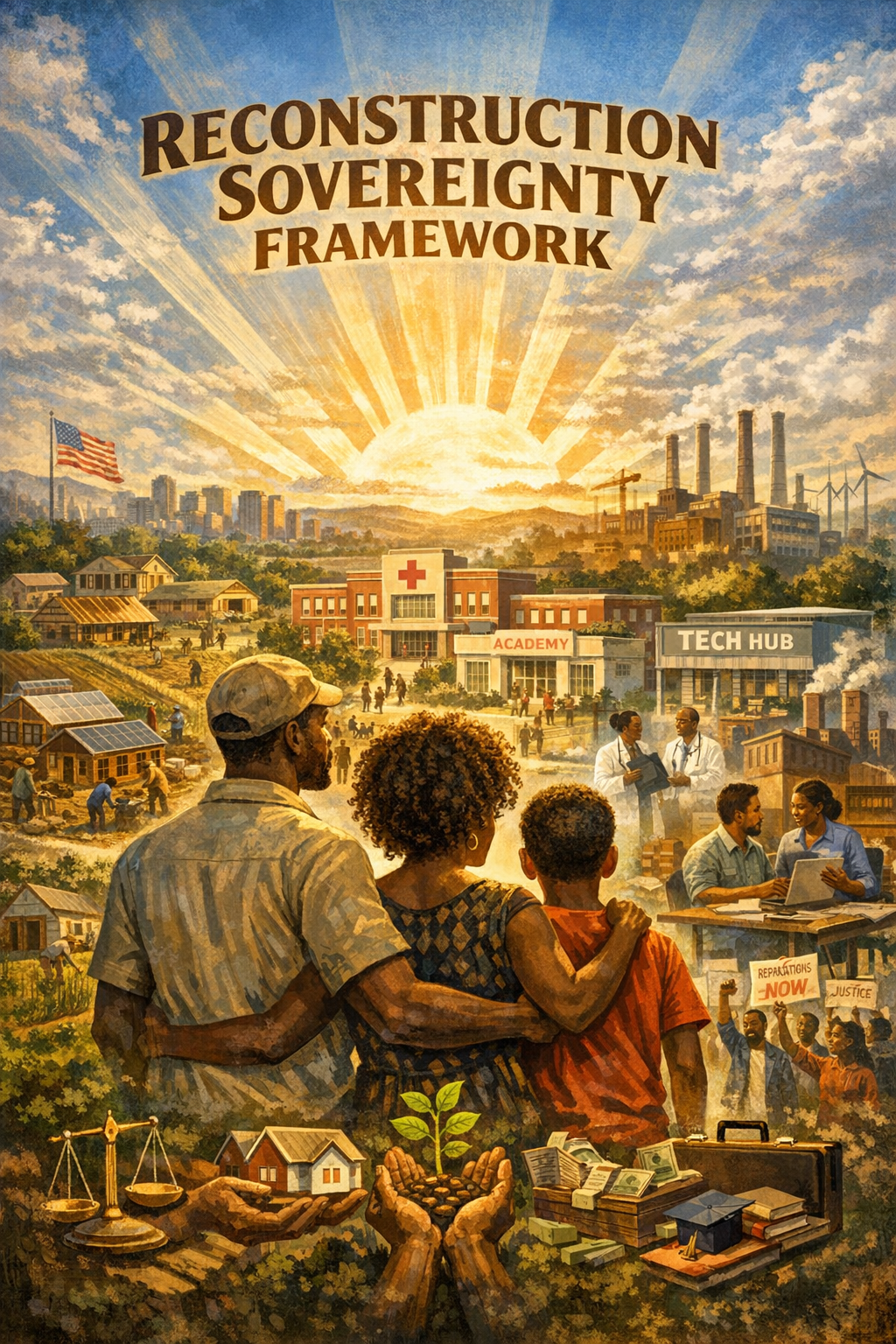
Reconstruction Sovereignty Framework: Naming the Crisis and the Vision
The conditions facing American descendants of slavery represent one of the most profound and persistent emergencies in the United States.
Across health, wealth, employment, education, environment, and infrastructure, the data reveal a pattern of decline that is neither accidental nor natural. It is the cumulative result of centuries of extraction, exclusion, and state‑sanctioned neglect. In this moment of accelerating disparity, the nation stands at a crossroads: continue down a path that allows an entire lineage to erode or commit to a generational project of repair and reconstruction.
America’s accelerating “shifting baselines” reveal a democracy quietly mutating into something unrecognizable, normalizing dysfunction so thoroughly that each new generation accepts degraded governance as the status quo. Shifting baselines: The erosion of American democracy
Warnings that massive, unread bills passed overnight, and routine government shutdowns now seem ordinary illustrates how far the system has drifted from functional norms. This erosion aligns with the logic of The Democracy Breakpoint: once institutions weaken past a critical threshold, collapse accelerates rapidly, as seen in the sharp drop in America’s democratic score and the consolidation of executive power. Century’s New Democracy Meter Shows America Took an Authoritarian Turn in 2025
For ADOS communities, already disproportionately harmed by state neglect, civil‑rights rollbacks, authoritarian policy shifts, surrounded by NIMBY (Not in my back yard) progressive/liberal communities, and political representation that abandons its most in need constituents to chase headlines or personal aspirations, the consequences are catastrophic.
As democratic guardrails fail, the groups with the least institutional protection and political power face the most severe outcomes: intensified disenfranchisement, targeted surveillance, economic dispossession, historic regression, decline, and shrinking avenues for political redress.
The terrifying insight is that by the time the baseline has shifted enough for the broader public to notice, ADOS communities may already be living in the aftermath of democratic collapse as the first group ushed into the coming useless class.
The Reconstruction Sovereignty Framework emerges as a response to this crisis, a blueprint for rebuilding ADOS communities through land ownership, infrastructure renewal, institution‑building, and community‑led governance.
It is not a metaphor. It is a structural model designed to reverse measurable decline and create the conditions for long‑term stability, autonomy, and prosperity. The framework asserts that survival is not enough; what is required is the capacity to thrive, to build, and to shape the future on our own terms, with the full cooperation of the government that sanctioned the plunder.
The urgency is unmistakable. Life expectancy gaps between Black and white Americans remain wide, with Black Americans experiencing significantly higher rates of chronic disease and maternal mortality.
Wealth disparities are staggering with median Black household wealth remaining a fraction of white household wealth, and Black homeownership rates have barely moved since the 1960s. Many historically Black neighborhoods face deteriorating infrastructure, environmental hazards, and disinvestment that undermine health, safety, educational, and economic mobility. These conditions are not isolated; they form an interconnected ecosystem of disadvantage.
The Reconstruction Sovereignty Framework argues that the only adequate response is a comprehensive, federally backed reconstruction effort rooted in three foundational commitments.
Land as the anchor of sovereignty, ensuring that ADOS communities control the physical ground on which institutions, industries, and neighborhoods are built.
Infrastructure repair as the first operational phase, addressing the environmental, structural, and public health crises that make thriving impossible.
Community‑led planning, ensuring that residents, local leadership, and organizations guide redevelopment rather than being displaced by it or having it controlled by outsiders.
This is not a call for incremental reform. It is a call for a new era of reconstruction, one that recognizes the scale of historical harm and the scale of investment required to repair it.
The Reconstruction Sovereignty Framework positions ADOS communities not as passive recipients of aid but as architects of their own future, equipped with the land, funding, institutions, and leadership pipelines necessary to build enduring power.
The vision is clear: a network of thriving, self‑determined enclaves anchored by Black‑owned land, modern infrastructure, community‑controlled healthcare and education systems, and industries that generate wealth and opportunity. This is the foundation for generational stability. This is the path toward sovereignty. And this is the work that must begin now.
Historical Context — The Long Arc of Extraction and Exclusion
The conditions confronting African American descendants of slavery cannot be understood without tracing the uninterrupted lineage of extraction, exclusion, and structural dispossession that shaped every generation from the 17th century to the present. The Era of Reconstruction: 1861-1900 Theme Study
The Reconstruction Sovereignty Framework rests on the recognition that today’s disparities are not anomalies; they are the predictable and direct outcomes of policies, institutions, and economic systems designed to extract value from Black human beings and their labor while denying them and their communities’ access to land, capital, and political power.
This section provides a deeper historical foundation for that argument, showing how each era of American development produced new mechanisms of exclusion that continue to shape ADOS life today.
The Aftermath of Emancipation: Freedom Without Land
The end of chattel slavery in 1865 marked a legal transformation but not an economic one. Four million newly freed people entered a society where they had no land, no capital, and no legal protections against exploitation.
The promise of “forty acres and a mule” was never fulfilled, and the federal government returned millions of acres of confiscated Confederate land to former enslavers. This decision cemented a racialized land imbalance that persists today. Reconstruction, 1865-1877 | Slavery, Abolition, Emancipation and Freedom – CURIOSity Digital Exhibits
By 1910, Black farmers had managed to acquire roughly 14 million acres of land through extraordinary collective effort. Over the next century, more than 90% of that land was lost through discriminatory lending, legal manipulation, violence, and federal inaction.
The Reconstruction Sovereignty Framework identifies this moment, the denial of land at emancipation, as the foundational breach that shaped every subsequent form of inequality.
Jim Crow and the Architecture of Racial Control
Following Reconstruction, Southern states constructed a legal and economic system designed to replicate slavery’s labor extraction under new names. Sharecropping, tenant farming, and debt peonage trapped millions of Black families in cycles of poverty. Convict leasing, where Black men were arrested in masse for minor or fabricated offenses, supplied states and corporations with nearly free labor.
This era also saw the rise of racial terror. Thousands of lynchings and acts of mob violence were used to suppress Black political participation, drive families from their land, and enforce a racial caste system. These acts were not isolated; they were tools of economic control. The Reconstruction Era and the Fragility of Democracy | Facing History & Ourselves
The Reconstruction Sovereignty Framework views this period as the second major wave of dispossession, where land, labor, and life itself were systematically extracted to maintain white economic dominance.
The 20th Century: Policy‑Driven Exclusion at National Scale
As the United States industrialized, federal policy became the primary engine of racial inequality. Programs that built the white middle class were systematically denied to Black Americans.
Redlining and Housing Segregation
Beginning in the 1930s, federal housing agencies created maps that labeled Black neighborhoods as “hazardous,” cutting them off from mortgage credit. This prevented Black families from buying homes in appreciating areas and locked them into segregated, underfunded districts.
Between 1934 and 1962, less than 2% of all FHA‑insured mortgages went to Black families. White homeownership soared, creating generational wealth; Black homeownership stagnated and was basically nonexistent.
The GI Bill
After World War II, millions of veterans received subsidized education, housing, and business loans. In practice, Black veterans were excluded through local discrimination, university segregation, and banking bias.
Urban Renewal and Highway Construction
Mid‑century redevelopment projects destroyed hundreds of Black neighborhoods, displacing families and businesses. Highways were deliberately routed through Black communities, fracturing social networks and accelerating decline.
These policies did not merely disadvantage Black Americans, they actively transferred wealth upward and outward, creating the massive racial wealth gap that persists today.
Environmental Racism and Industrial Abandonment
As manufacturing declined in the late 20th century, many Black communities were left with abandoned industrial sites, toxic waste, and deteriorating infrastructure. These environmental burdens contributed to higher rates of asthma, cancer, and chronic disease.
Historically redlined neighborhoods today have significantly higher exposure to air pollution and heat. Many Black communities face aging water systems, crumbling infrastructure, lead contamination, and failing housing stock.
The Reconstruction Sovereignty Framework identifies environmental repair as a core pillar because environmental harm has been one of the most consistent and devastating forms of structural exclusion.
Mass Incarceration and the Extraction of Human Capital
Beginning in the 1970s, punitive criminal justice policies disproportionately targeted Black communities. Mandatory minimums, drug laws, and aggressive policing removed millions of Black men and women from their families, labor markets, and communities.
Black Americans are incarcerated at more than five times the rate of white Americans. Entire neighborhoods experienced demographic collapse, economic stagnation, and political disenfranchisement.
This era represents a modern form of extraction, removing human capital from communities and redirecting public resources toward policing and incarceration rather than education, health, or economic development.
The Present: A Crisis Rooted in History
Today’s disparities in wealth, health, education, and infrastructure are the cumulative result of these historical forces. They are not accidental. They are not cultural. They are structural, measurable, sanctioned, and deeply embedded in the nation’s economic and political systems.
The Reconstruction Sovereignty Framework argues that only a comprehensive, land‑centered, infrastructure‑first reconstruction effort can reverse these patterns. Incremental reforms cannot repair centuries of extraction. What is required is a generational, ongoing project of restoration, sovereignty, and institution‑building.
The Current Emergency — Data on ADOS Decline
The present condition of African American descendants of slavery reflects a convergence of crises across health, wealth, economic, educational, environment, and infrastructure.
These crises are not isolated; they form a mutually reinforcing system of decline that threatens long‑term demographic stability, economic mobility, and community viability. Understanding this emergency requires examining the measurable indicators that define ADOS life today. Each data point represents not only a contemporary disparity but the cumulative impact of historical extraction and exclusion.
Health Outcomes and Life Expectancy
Health disparities remain among the most severe indicators of ADOS decline. Black Americans experience significantly higher rates of chronic illness, maternal mortality, and premature death compared to white Americans. These disparities persist across income levels, geographic regions, and age groups, reflecting systemic inequities in access to care, environmental conditions, and social determinants of health.
Maternal mortality rates for Black women are several times higher than those for white women, even when controlling for education and income.
Life expectancy for Black Americans remains lower than for white Americans, with gaps driven by chronic disease, violence, and environmental exposure.
Rates of hypertension, diabetes, asthma, and cardiovascular disease are disproportionately high in historically Black neighborhoods, many of which face limited access to primary care and specialty services. Most are food desserts.
Environmental hazards such as lead exposure, industrial pollution, and poor air quality are concentrated in communities shaped by redlining and disinvestment.
These health outcomes are not merely medical issues; they are structural indicators of a community under sustained stress and severe state sanctioned oppression. They also directly affect economic participation, educational attainment, and long‑term community stability.
Wealth, Income, and Economic Mobility
The lineage wealth gap remains one of the most persistent and well‑documented disparities in the United States. Black households hold a fraction of the wealth of white households, a gap that has remained largely unchanged for centuries. Wealth is the foundation of economic security, homeownership, business development, and intergenerational stability, and its absence limits mobility across generations.
Median Black household wealth is dramatically lower than median white household wealth, reflecting historical barriers to land ownership, homeownership, and capital access. Black homeownership rates have barely increased since the 1960s, despite fair housing legislation, and remain significantly below white homeownership rates.
Black‑owned businesses face higher barriers to credit, lower startup capital, and greater vulnerability to economic shocks.
Income disparities persist across industries, with Black workers concentrated in lower‑wage sectors and underrepresented in high‑growth fields such as technology and finance. Sectors that will be the first eliminated by AI, automation, and robotics.
These economic indicators reveal a structural pattern: ADOS communities have been systematically excluded from the mechanisms that generate and preserve wealth in the United States. Without intentional, governmental intervention, these disparities will continue to widen.
Infrastructure, Housing, and Environmental Conditions
Many historically Black neighborhoods face deteriorating infrastructure, aging housing stock, and environmental hazards that undermine health, safety, and economic development. These conditions are the result of decades of disinvestment, discriminatory zoning, and the abandonment of public infrastructure.
Water systems in many Black communities show higher rates of contamination, including lead and other toxins. Housing in historically redlined neighborhoods is more likely to be in poor condition, with structural issues that pose health and safety risks.
Public transportation networks often bypass or inadequately serve Black neighborhoods, limiting access to jobs, healthcare, and education. Abandoned industrial sites, brownfields, and waste facilities are disproportionately located in Black communities, contributing to environmental health risks.
These environmental and infrastructural conditions create barriers to redevelopment and economic growth. They also contribute to the health disparities noted earlier, forming a cycle of decline that is difficult to break without large‑scale intervention and committed Black leadership
Education and Human Capital Development
Educational disparities continue to shape long‑term outcomes for ADOS communities. Schools in predominantly Black neighborhoods often face underfunding, overcrowding, and limited access to advanced coursework and extracurricular programs.
School districts serving Black students receive significantly less funding per pupil than those serving predominantly white students. Black students are more likely to attend schools with fewer resources, older facilities, and higher teacher turnover.
Disparities in access to advanced placement courses, STEM programs, and college preparatory resources limit opportunities for upward mobility. Not to mention the skyrocketing cost of higher education.
Disciplinary disparities result in higher suspension and expulsion rates for Black students, contributing to long‑term educational and economic consequences. These educational disparities reduce the pipeline of Black professionals in high‑income fields and limit the capacity of communities to build and sustain institutions.
Demographic and Political Vulnerability
Demographic trends show that Black population growth has slowed, and in some regions, Black populations are declining due to displacement, economic pressures, and health disparities. Political representation is also affected by these demographic shifts, as well as by structural barriers to voting and civic participation.
Population decline in historically Black neighborhoods is often driven by displacement and rising housing costs due to intentional gentrification under the guise of diversity and economic renewal.
Political influence is weakened when communities are fragmented, displaced or lack committed leadership.
Barriers to voting, including restrictive laws and limited access to polling places, disproportionately affect Black voters. These trends underscore the urgency of stabilizing and rebuilding ADOS communities through comprehensive reconstruction efforts.
A Convergence of Crises
The data across health, wealth, infrastructure, education, and demographics reveal a community facing a multidimensional emergency.
These crises are interconnected, each reinforcing the others. Health disparities limit economic participation; economic disparities limit access to quality housing and education; environmental hazards exacerbate health issues; and political vulnerability limits the ability to secure resources and protections.
The Reconstruction Sovereignty Framework — Core Principles
The Reconstruction Sovereignty Framework rests on the understanding that ADOS decline is not the result of isolated failures but of a comprehensive system of dispossession.
Repair, therefore, must be equally comprehensive. This framework identifies three foundational pillars—land, infrastructure, and community governance—that together create the conditions for rebuilding stable, thriving, self‑determined Black communities. Each principle addresses a specific historical breach while enabling the next phase of institution‑building.
Land as the Anchor of Collective Power
Land is the foundation of every durable community. It determines who controls development, who benefits from rising property values, and who has the authority to build institutions that serve long‑term needs. For ADOS communities, land has been the most consistently denied resource, from the broken promise of post‑emancipation land redistribution to the widespread loss of Black farmland in the 20th century.
The Reconstruction Sovereignty Framework positions land ownership as the first and most essential step toward reconstruction. Three complementary models form the backbone of this approach:
Community Land Trusts preserve affordability, prevent displacement, and ensure that land remains under community control in perpetuity.
Cooperative Ownership allows residents and workers to collectively own commercial corridors, industrial zones, and mixed‑use developments, ensuring that economic gains circulate within the community.
Federal Land Grants provide the scale necessary to rebuild entire neighborhoods, establish institutions, and correct the historical denial of land at emancipation. And a commitment from major philanthropic organizations.
Together, these mechanisms create a layered system of protection that prevents extraction and anchors long‑term sovereignty.
Infrastructure Repair as the First Operational Phase
Infrastructure is the physical expression of a community’s value in the eyes of the state. For ADOS neighborhoods, decades of disinvestment and decline management leadership have produced deteriorating water systems, crumbling infrastructure, failing housing stock, unsafe streets, and environmental hazards that undermine health and economic mobility.
Before schools, clinics, or industries can thrive, the land itself must be made safe, modern, and functional.
The Reconstruction Sovereignty Framework identifies infrastructure repair as the first operational phase of reconstruction. This includes sidewalks, streets, modernizing water, sewage, electrical, and broadband systems to eliminate hazards and support future development.
Removing blight, demolishing unsafe structures, and remediating toxic land to create clean, usable space. Rebuilding transportation networks to reconnect communities to jobs, healthcare, and education. Restoring public spaces that support safety, recreation, and social cohesion.
This phase prepares the physical environment for the institutions that will follow. It also creates immediate employment opportunities and builds local capacity through apprenticeships and workforce development.
Community‑Led Planning and Governance
Reconstruction cannot be imposed from outside. Historically, top‑down planning coupled with decline management leadership has displaced Black residents, erased cultural identity, and transferred wealth to outside developers.
The Reconstruction Sovereignty Framework insists that ADOS communities must lead every stage of planning, decision‑making, and implementation.
Community‑led governance includes resident Assemblies that shape land use, redevelopment priorities, and institutional design.
The cultivation of new Local Leadership Development to cultivate planners, organizers, engineers, educators, and public health leaders from within the community. Transparent Governance Structures that ensure accountability, prevent corruption, and protect community interests from current decline management leadership, which is currently devastating ADOS communities across the country.
Anti‑Displacement Protections that guarantee residents can remain in their neighborhoods as redevelopment occurs.
This approach transforms residents from passive subjects of policy into active architects of their own future. It also ensures that redevelopment aligns with cultural identity, historical memory, and long‑term community goals. How These Principles Work Together
The Reconstruction Sovereignty Framework is designed as an interlocking system land ownership provides the physical foundation. Infrastructure repair prepares the environment for growth. Community governance ensures that development reflects collective priorities.
Once these pillars are in place, the next phase, building healthcare systems, educational institutions, and economic industries, can occur on stable ground. This sequencing is essential.
Without land, institutions can be displaced. Without infrastructure, institutions cannot function. Without community governance, institutions can be captured by outside interests and local decline management leadership.
The framework is not simply a policy model; it is a blueprint for generational transformation. It recognizes that ADOS communities require not only repair but sovereignty, the ability to shape their own destiny through control of land, resources, and institutions.
Building the Three Urgent Pillars
The Reconstruction Sovereignty Framework identifies three institutional pillars—healthcare, education, and industry, as the engines of long‑term stability and generational power.
These pillars are not interchangeable; each addresses a specific dimension of decline, and together they form the infrastructure of a self‑sustaining community. Once land is secured, infrastructure repaired, and governance established, these pillars become the core of reconstruction.
Healthcare Systems Rooted in Community Control
Health is the foundation of every other form of participation—economic, educational, civic, and cultural. ADOS communities face disproportionate burdens of chronic disease, environmental exposure, and limited access to care. A reconstruction strategy must therefore begin with the creation of healthcare systems that are physically located in, governed by, and accountable to the communities they serve.
Key components include community‑controlled clinics and hospitals that provide primary care, maternal health services, chronic disease management, and mental health support.
Training pipelines that prepare Black medical professionals, nurses, physicians, technicians, public health workers, to staff and lead these institutions.
Environmental health interventions that address the legacy of industrial dumping, lead exposure, and air pollution in historically redlined neighborhoods.
Preventive care and wellness programs that reduce long‑term healthcare costs and improve quality of life.
These systems become anchors of stability, reducing preventable illness and creating a healthier population capable of participating fully in economic and educational life.
Education Systems Designed for Human Capital Development
Education is the engine of mobility and the foundation of institutional leadership. Yet many ADOS communities face underfunded schools, limited access to advanced coursework, and high teacher turnover. A reconstruction strategy must therefore build educational institutions that are culturally grounded, academically rigorous, and aligned with long‑term economic and Black survival goals.
Essential elements include Black‑controlled K–12 schools that integrate cultural history, financial literacy, STEM education, and civic leadership.
Onsite vocational and technical training centers that prepare students for careers in construction, engineering, healthcare, and technology. Partnerships with top tier universities and research institutions to create pipelines into high‑growth fields.
Teacher training programs that cultivate educators from within the community. Adult education and workforce development to support lifelong learning.
These institutions produce the planners, engineers, healthcare workers, and entrepreneurs who will lead the next phases of reconstruction.
Industry and Technology as Engines of Economic Power
Economic sovereignty requires more than jobs; it requires ownership of the industries that generate wealth. Historically, ADOS communities have been excluded from capital access, industrial development, and high‑growth sectors. The Reconstruction Sovereignty Framework therefore prioritizes the creation of industries that are locally owned, strategically developed, and aligned with future economic trends.
Core strategies include technology hubs that support software development, automation, robotics, digital media, cybersecurity, and data science. Manufacturing and logistics centers that leverage regional infrastructure and create stable, well‑paid jobs.
Cooperative enterprises that distribute profits among workers and residents. Media and cultural institutions that shape narrative, preserve history, and generate creative capital. Business incubators and targeted capital funds that support Black entrepreneurs and innovators.
These industries create a diversified economic base that can withstand market fluctuations and support long‑term community investment.
How the Three Pillars Reinforce Each Other
The pillars are designed to function as an integrated system Healthcare improves population health, enabling greater participation in education and the workforce. Education produces the skilled workforce needed to staff and lead healthcare systems and industries. Industry generates the wealth that funds sustainable healthcare, education, and community development.
This interdependence is intentional. The Reconstruction Sovereignty Framework is not a collection of isolated reforms; it is a coordinated strategy for rebuilding the institutional ecosystem required for generational stability.
Leadership Pipelines — Training the Architects of Reconstruction
Reconstruction on the scale envisioned in the Reconstruction Sovereignty Framework requires a sustained, multi‑generational investment in committed and new Black leadership, as well as allies.
Land, infrastructure, and institutions cannot function without people who are trained to design, govern, and protect them. Leadership development is therefore not an auxiliary component of reconstruction, it is the engine that ensures continuity, accountability, and long‑term sovereignty.
A leadership pipeline must be broad enough to cultivate planners, engineers, educators, healthcare professionals, cooperative managers, environmental scientists, and civic leaders. It must also be deep enough to replenish itself over time, ensuring that each generation produces the next wave of architects, administrators, and visionaries.
Formal Training Programs for Technical and Administrative Expertise
Formal programs provide the specialized knowledge required to manage complex systems. These programs create a steady flow of professionals who can oversee land trusts, design infrastructure, run healthcare institutions, and lead educational systems.
Key domains include Urban planning and zoning. Civil and environmental engineering. Public health administration. Cooperative and land‑trust governance. Education leadership and superior curriculum design. Economic development and finance
These prioritized programs establish the technical backbone of reconstruction, ensuring that communities have the expertise to negotiate with larger, outside government agencies, manage large‑scale projects, and maintain institutional stability.
Fellowships and Leadership Cohorts for Strategic Thinkers
Fellowships cultivate leaders who can think beyond immediate needs and shape long‑term strategy. They create networks of individuals who understand policy, community organizing, and institutional development.
Core focus areas include policy analysis and legislative strategy. Community organizing and civic engagement. Institutional governance and accountability. Economic strategy and industry development. Cultural preservation and narrative leadership.
These cohorts form the intellectual and strategic core of reconstruction, producing leaders who can articulate vision, build coalitions, and guide institutions through periods of change.
University, philanthropic, and Institutional Partnerships for Advanced Capacity Building.
Partnerships with top universities, research centers, and technical institutes accelerate the development of specialized talent. These collaborations bring academic resources into the community while ensuring that training remains aligned with local priorities.
Potential areas of collaboration include joint planning studios for neighborhood redevelopment. Public health and environmental justice research. Engineering and architecture partnerships. Business incubators and innovation labs. Teacher and medical professional pipelines.
These partnerships expand the community’s capacity to train experts in fields that require advanced education, while maintaining local control over priorities and outcomes.
Community‑Based Apprenticeships for Practical, On‑the‑Ground Skills
Apprenticeships root leadership development in the lived experience of the community. They allow residents to learn by doing, participating directly in the reconstruction of their neighborhoods.
Key apprenticeship pathways include construction, infrastructure repair, and environmental remediation. Cooperative business management and entrepreneurship. Healthcare support roles and community health work. Media production, technology, and digital literacy. Land‑trust governance and community planning.
These programs ensure that reconstruction creates jobs, builds skills, and strengthens community ownership simultaneously.
Interdependence of the Leadership Pipelines
The leadership pipelines are designed to function as an integrated system Formal programs produce technical experts. Fellowships produce strategic thinkers. University partnerships produce advanced specialists. Apprenticeships produce practical, community‑rooted leaders.
Together, they create a leadership ecosystem capable of sustaining the institutions built through the Reconstruction Sovereignty Framework. This ecosystem ensures that no single institution becomes vulnerable to external capture, internal mismanagement, or generational turnover.
Governance and Accountability
Governance determines whether reconstruction becomes a durable system or a temporary intervention.
The Reconstruction Sovereignty Framework places governance at the center because land, infrastructure, and institutions cannot protect themselves. They require structures that ensure transparency, continuity, and community control. Without committed governance, even the most ambitious reconstruction efforts risk being captured by outside interests, weakened by internal fragmentation, or undone by political shifts.
Federal Structures for Oversight and Protection
A national framework is essential for ensuring that reconstruction is implemented consistently and protected from political volatility. A dedicated ADOS federal entity would serve as the anchor for data collection, enforcement, and long‑term oversight.
Its responsibilities would include monitoring disparities, coordinating with local governments, and ensuring that reconstruction resources reach the communities they are intended to serve. This type of federal structure would also help standardize protections across regions, preventing uneven implementation and reinforcing the long‑term stability of reconstruction efforts.
Local Governance Rooted in Community Authority
Local governance is where reconstruction becomes real. Committed Black leadership, community boards, land‑trust councils, and cooperative boards provide the mechanisms through which residents shape development, manage resources, and hold institutions accountable.
These bodies ensure that decisions reflect local priorities rather than external agendas. Resident assemblies can serve as forums for deliberation, allowing community members to participate directly in planning and oversight. This approach strengthens civic engagement and builds a culture of shared responsibility.
Safeguards Against Displacement and Extraction
Reconstruction must include protections that prevent displacement, gentrifiers, erasure, and ensure that economic gains remain within the community. Anti‑speculation measures can help stabilize housing markets and prevent rapid price increases that push out long‑term residents.
Community benefit agreements can ensure that new developments provide tangible advantages, such as jobs, affordable housing, or public amenities. Long‑term affordability protections can help maintain access to housing and commercial space, preserving the social and economic fabric of the community.
Accountability Mechanisms for Transparency and Trust
Transparency is essential for maintaining trust and ensuring that reconstruction efforts remain aligned with community goals. Regular reporting, public meetings, and accessible data can help residents understand how resources are being used and what progress is being made. Independent audits and oversight committees can provide additional layers of accountability, ensuring that institutions operate with integrity and that community interests remain at the forefront.
Integration of Governance and Leadership Pipelines
Governance structures must be supported by the leadership pipelines described earlier. Trained planners, engineers, educators, healthcare professionals, and cooperative managers are essential for effective governance.
These leaders bring the expertise needed to manage complex systems and ensure that institutions remain responsive to community needs. By integrating new Black leadership development with governance, the Reconstruction Sovereignty Framework creates a sustainable model that can adapt to changing conditions and maintain long‑term stability.
Economic Instruments for Generational Wealth
Economic stability is the backbone of any long‑term reconstruction effort. Without durable wealth‑building mechanisms, even the strongest institutions, schools, clinics, cooperatives, and cultural centers, remain vulnerable to market shocks, political shifts, and external capture.
The Reconstruction Sovereignty Framework treats economic instruments not as add‑ons but as structural components that ensure communities can sustain themselves across generations. These instruments must be designed to circulate capital internally, protect assets from extraction, and create pathways for upward mobility that are resilient and scalable.
Homeownership as a Foundation of Stability
Homeownership has historically been the primary engine of wealth accumulation in the United States, yet ADOS communities have been systematically excluded from this pathway. A reconstruction strategy must therefore create mechanisms that expand access to homeownership while protecting residents from displacement and predatory practices.
Key approaches include subsidized mortgages that reduce barriers to entry and make homeownership attainable for families who have faced generations of exclusion. Down‑payment assistance that addresses the wealth gap directly by providing the capital needed to secure property.
Housing cooperatives that allow residents to collectively own and manage multi‑unit buildings, ensuring long‑term affordability and community control. Community‑owned developments that keep land and housing within the community, preventing speculative investment and displacement.
These instruments create a stable base of residential ownership that anchors families and strengthens neighborhood cohesion.
Business Capital to Build Local Economies
Entrepreneurship and business ownership are essential for creating jobs, generating income, and building economic resilience. ADOS entrepreneurs often face barriers to credit, limited access to startup capital, and structural disadvantages in competitive markets. Reconstruction must therefore include targeted investments that support business creation and growth.
Effective tools include targeted grants that provide non‑repayable capital for startups and expansions, reducing financial risk for new entrepreneurs. Low‑interest loans that offer affordable financing for equipment, inventory, and operational costs.
Cooperative business incubators that provide shared resources, mentorship, and training for worker‑owned enterprises. Industrial development funds that support manufacturing, logistics, and technology ventures capable of generating significant employment.
These instruments help build a diversified economic base that can support community needs and withstand economic fluctuations.
Retirement and Investment Vehicles for Long‑Term Security
Generational wealth requires more than income; it requires assets that grow over time and provide security in retirement. Many ADOS workers lack access to employer‑sponsored retirement plans or investment opportunities, leaving them vulnerable in later life. Reconstruction must therefore create investment vehicles that are accessible, community‑controlled, and designed to build wealth over decades.
Key strategies include community investment trusts that allow residents to invest in local developments and share in the returns. Black controlled and federally backed pension systems that provide stable retirement income and reduce reliance on social safety nets.
Endowments for schools and hospitals that ensure long‑term funding for essential institutions. Wealth‑building accounts for children that provide a financial foundation for education, homeownership, or entrepreneurship.
These instruments create a financial infrastructure that supports individuals and institutions across generations.
How Economic Instruments Reinforce Reconstruction
Economic instruments are not isolated tools; they are interconnected components of a broader strategy. Homeownership stabilizes families and neighborhoods. Business capital creates jobs and supports local industries. Retirement and investment vehicles provide long‑term security and institutional stability. Together, they form an economic ecosystem that supports the pillars of healthcare, education, and industry.
The Moral, Economic, and Democratic Imperative
The conditions facing communities harmed by centuries of exclusion present a challenge that reaches far beyond any single neighborhood or demographic group. They raise questions about the nation’s identity, its economic future, and the stability of its democratic institutions.
When disparities become entrenched across health, wealth, education, and infrastructure, the consequences ripple outward, shaping national productivity, social cohesion, and long‑term resilience. The Reconstruction Sovereignty Framework situates these issues within a broader national context, arguing that comprehensive reconstruction is not only a matter of justice but a requirement for the country’s future strength.
A Moral Imperative Rooted in Historical Responsibility
The historical record shows that many of the disparities observed today are the direct result of policies that systematically excluded certain communities from land ownership, capital access, and institutional protection. These policies were not incidental; they were embedded in housing markets, labor systems, financial institutions, and public infrastructure. A moral response requires acknowledging this history and addressing its consequences with solutions that match the scale of the harm.
Generational wealth gaps reflect decades of discriminatory lending and land dispossession.
Health disparities mirror environmental burdens and unequal access to care. Educational inequities stem from funding structures tied to segregated housing patterns.
Repairing these conditions is not an act of charity. It is a recognition that the nation’s prosperity was built through systems that advantaged some while disadvantaging others. A moral framework for reconstruction acknowledges this imbalance and seeks to correct it through sustained, structural investment.
An Economic Imperative for National Competitiveness
Economic growth depends on a healthy, educated, and fully participating population. When large segments of the population face barriers to mobility, the entire economy absorbs the cost. Lost productivity, increased healthcare expenditures, and reduced consumer spending all contribute to slower national growth. Addressing these disparities is therefore not only a matter of justice but a strategic economic investment.
Healthier communities reduce long‑term medical costs and increase workforce participation. Stronger educational systems expand the pool of skilled workers needed for emerging industries. Local business development stimulates regional economies and strengthens supply chains. Infrastructure improvements create jobs and support long‑term economic resilience.
The Reconstruction Sovereignty Framework emphasizes that economic revitalization is inseparable from social repair. By investing in communities that have historically been excluded, the nation strengthens its overall economic foundation.
A Democratic Imperative for Stability and Legitimacy
Democracy depends on broad participation, trust in institutions, and a sense of shared belonging. When communities experience persistent disparities, political engagement declines, trust erodes, and social fragmentation increases. These conditions weaken democratic institutions and create vulnerabilities that can be exploited by misinformation, polarization, and instability.
Disparities in political representation undermine the legitimacy of democratic processes. Economic insecurity reduces civic participation and increases disillusionment.
Displacement, Black misleadership, and neighborhood decline weaken community networks essential for democratic engagement.
Reconstruction strengthens democracy by ensuring that all communities have the resources, stability, and institutional support needed to participate fully in civic life. It reinforces the idea that democracy is not self‑sustaining; it requires active investment in the conditions that allow people to engage meaningfully.
The Case for a Comprehensive Framework
The moral, economic, and democratic imperatives converge on a single conclusion. Addressing entrenched disparities requires a coordinated, long‑term strategy. The Reconstruction Sovereignty Framework provides a structure for this work by integrating land ownership, infrastructure repair, institutional development, and leadership pipelines into a unified approach.
This framework recognizes that piecemeal reforms cannot reverse generations of exclusion. Only a comprehensive reconstruction effort can create the conditions for lasting stability and shared prosperity.
Conclusion — A Call to Build the Future
A reconstruction effort worthy of the name must look beyond crisis response and toward the creation of a durable future.
The Reconstruction Sovereignty Framework brings together land, infrastructure, institutions, leadership, and economic instruments into a single, interdependent system capable of reversing decline and building generational strength. Its purpose is not only to repair what has been broken but to establish the conditions under which communities can thrive, innovate, and shape their own destinies.
A Future Built on Stability and Self‑Determination
Stability begins with secure land, modern infrastructure, federal capital, and institutions that reflect community priorities. These foundations create the space for families to build lives, for businesses to grow, and for leaders to emerge.
Self‑determination requires governance structures that protect community interests, ensure transparency, and cultivate accountability. Together, these elements form the backbone of a future in which communities are not merely surviving but actively shaping their environments.
A Future Built on Health, Knowledge, and Industry
Black systems rooted in community control improve quality of life and expand the capacity for participation in education and the workforce.
Black Educational institutions designed for long‑term development produce the planners, engineers, teachers, political leaders, and innovators who will guide future generations. Locally owned industries generate wealth, create jobs, and anchor economic resilience.
These pillars reinforce one another, creating a cycle of growth that strengthens the entire community.
A Future Built on Generational Wealth
Economic instruments, homeownership, business capital, retirement systems, and community investment vehicles, provide the financial stability needed to sustain progress across generations. They ensure that gains are not temporary and that families have the resources to weather economic shifts. These tools transform reconstruction from a moment into a legacy.
A Future Built on Shared Responsibility
Reconstruction is not the work of a single institution or generation. It requires collaboration among residents, white allies, leaders, policymakers, educators, and economic partners.
It demands a long‑term commitment to building systems that are resilient, equitable, and capable of adapting to new challenges. The Reconstruction Sovereignty Framework offers a structure for this work, but its success depends on the collective will to implement it with clarity, discipline, and vision.
A Future Built on Possibility
The path forward is demanding, but it is also filled with possibility. Communities that have endured generations of exclusion possess deep reservoirs of resilience, creativity, and determination.
Reconstruction provides the opportunity to harness these strengths and build institutions that reflect the full potential of the people they serve. It is an invitation to imagine a future defined not by scarcity or decline but by stability, opportunity, and shared prosperity.
Leave a Reply