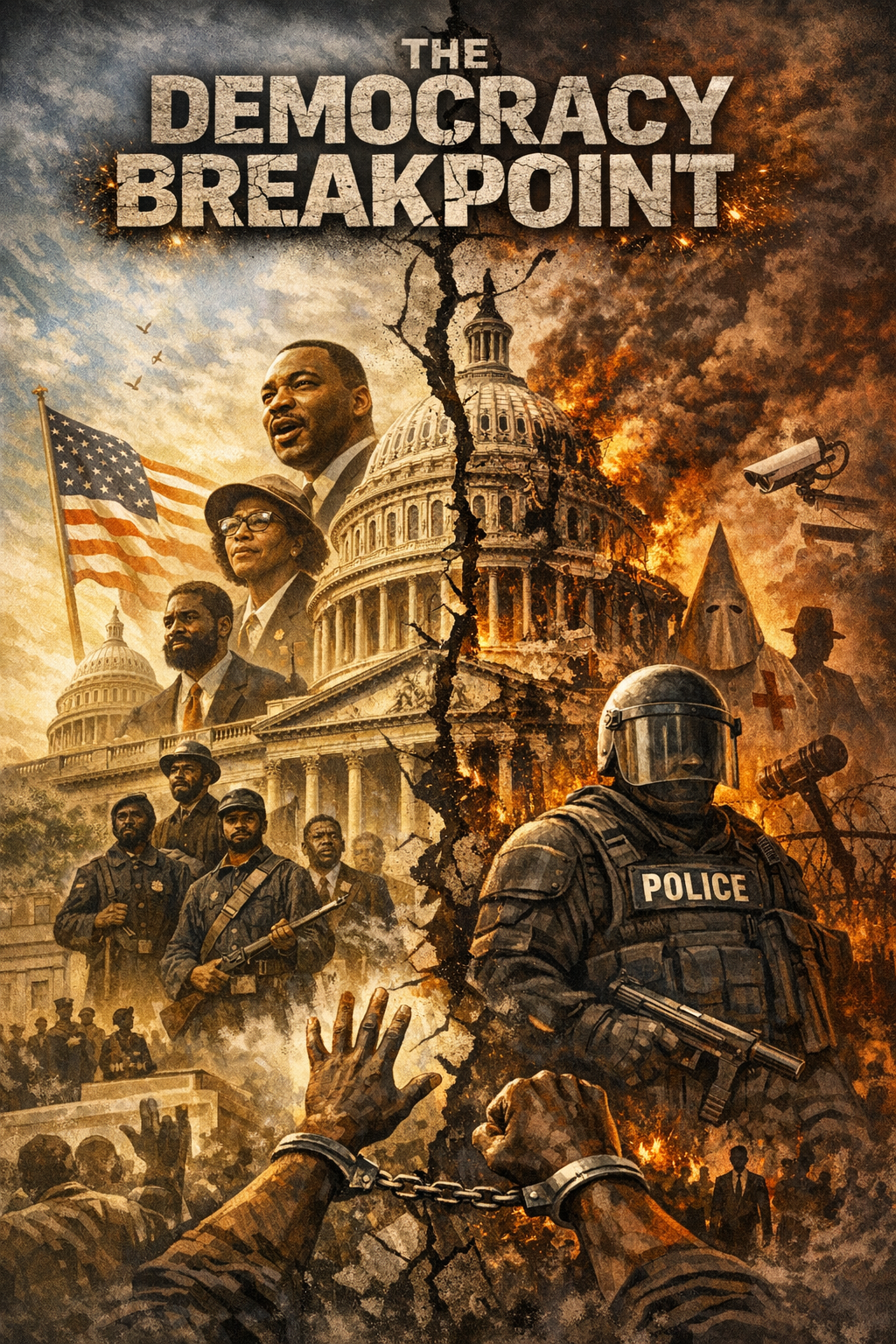
The Democracy Breakpoint How America Reached the Edge, and Why ADOS Stand at the Center of the Collapse.
There are moments in history when a nation crosses what can only be called a Democracy Breakpoint, a threshold beyond which institutions no longer bend, but break. The United States, according to a growing body of global research, congressional analysis, and lineage‑centered political critique, is now entering such a moment.
And at the center of this unraveling stands the very group that built the modern democratic order: American Descendants of Slavery (ADOS).
The phrase Democracy Breakpoint captures something the data now makes impossible to ignore. The United States is not merely experiencing political dysfunction, it is undergoing a measurable, historically unprecedented democratic reversal. And the consequences fall heaviest on the group whose struggle made American democracy possible in the first place.
The Democracy Breakpoint Arrives: What the V‑DEM Report Reveals
In its 2026 report, Unravelling the Democratic Era?, the V‑DEM Institute, the world’s most comprehensive democracy research center, issued a stark conclusion. The United States has experienced the most severe democratic backsliding in its recorded history.
Their findings, available in summary form here: V-DEM Democracy Report 2026 show that the U.S. has fallen to its lowest democratic rating since 1965, the year the Voting Rights Act was passed and with the rise of the Black Managerial class.
The country is now classified as “autocratizing”, joining a global wave of democratic decline. The primary driver is the concentration of power in the presidency, paired with the erosion of legislative and judicial constraints.
This is not rhetoric. It is empirical measurement across 48 indicators of democratic health. And it confirms what many ADOS thinkers including, us here at The Braddock Inclusion Project, have warned for years. The democracy ADOS built is being dismantled in real time.
This is the first major verification of the Democracy Breakpoint. The moment when democratic decline becomes structural, not cyclical.
Congress in Collapse: The Washington Post’s Recent Warning
The V‑DEM findings align with a recent Washington Post analysis, summarized publicly here Congress could be headed for a tipping point, irreversible decline
The article warns that Congress, the branch of government designed to represent the people, is approaching “irreversible decline.”
Key symptoms include chronic legislative paralysis, loss of institutional expertise, continuous attention seeking chaos, erosion of public trust, inability to check presidential power, and a growing dependence on executive action.
This collapse is not abstract. It has direct consequences for ADOS, who historically relied on Congress to secure Civil Rights Act protections, Voting Rights Act enforcement, Anti‑poverty programs, Fair housing legislation and Federal oversight of discriminatory states.
In a nutshell, when Congress weakens, ADOS protections weaken. When Congress collapses, what little political power ADOS has, collapses.
This is the second verification of the Democracy Breakpoint: the institutional center of gravity has shifted away from the people and toward the executive.
ADOS: The Democratic Foundation America Forgot
As history and the V-Dem report makes clear, ADOS are the democratic floor of the United States. This is not a metaphor. It is historical fact.
ADOS forced the end of slavery. ADOS built Reconstruction democracy. ADOS led the Civil Rights Movement. ADOS delivered universal suffrage. ADOS opened the door for new arrival migrants. ADOS have been the most loyal defenders of democratic norms for 150 years.
Every major democratic expansion in U.S. history has ADOS fingerprints on it. Yet the Democracy Breakpoint reveals a brutal irony. The very institutions ADOS built are collapsing at the moment when ADOS need them most.
The New Democratic Reversal: A Return to Pre‑1965 America
V‑DEM’s finding that U.S. democracy has fallen to 1965 levels is not symbolic, it is structural.1965 was the year the Voting Rights Act finally dismantled Jim Crow’s political machinery.
To fall back to that level means voting rights are stripped away. Federal oversight is diminished. State‑level suppression is rising. Racialized political power is re‑emerging. Coming minority rule is becoming entrenched and reinforced.
This is not a drift. It is a reversal, a return to the conditions ADOS fought to escape. The Democracy Breakpoint is not merely a political crisis. It is a historical regression.
The ADOS Political Squeeze: Why the Decline Hits Hardest Here
The collapse of democratic institutions disproportionately harms ADOS because ADOS rely most on federal protections.
State governments, especially in the South, have historically suppressed ADOS political power. Federal intervention was the only counterweight.
ADOS have the least economic insulation. Democratic decline increases inequality and ADOS ability to survive in America. ADOS communities, already at the bottom of the wealth distribution, absorb the shock first.
ADOS are targeted by voter suppression. Since the gutting of the Voting Rights Act in Shelby v. Holder, voter suppression laws have surged. State Voting Laws Roundup: 2024 in Review | Brennan Center for Justice
ADOS political identity is diluted by demographic shifts and management of decline political era which were the products of the rise of the Black managerial class. Immigration reshapes the “Black” category, weakening ADOS-specific political claims.
ADOS are overexposed to punitive state power. Mass incarceration, surveillance, and policing expand when democracy contracts.
This is the third verification of the Democracy Breakpoint. The collapse of democracy is not evenly distributed; it is racially patterned. The Global Context: America Joins the Autocratizing World
V‑DEM’s global findings show that 42% of the world’s population now lives in autocratizing countries. The U.S. is part of this wave. The world is experiencing a “Great Reversal”, a return to 1970s levels of democracy
This situates the U.S. not as an outlier, but as a leading indicator of global decline. The Democracy Breakpoint is not just national, it is planetary.
The Democracy Breakpoint: How Internal Elite Drift and National Institutional Decay Converged
The Frightening National Context and Urgent Call To ADOS: A Democracy in Structural Freefall
Recent V‑DEM data shows that the United States is experiencing one of the fastest democratic declines ever recorded in a modern Western democracy, with the country’s Liberal Democracy Index score dropping precipitously and its global ranking falling from the top 20 to the low 50s.
The deterioration is driven by the erosion of checks and balances, the weakening of rule of law, and the collapse of Congress as a co‑equal branch of government—a trend The Washington Post has described as an “irreversible decline” in legislative power.
This national democratic backsliding forms the backdrop against which Black political life must be understood. As federal institutions weaken, the groups with the least structural power—particularly American Descendants of Slavery (ADOS)—bear the brunt of the collapse.
The Rise of the Black Managerial Class: Representation Without Redistribution
Beginning in the post–civil rights era, a new Black managerial class emerged, professionals, administrators, nonprofit executives, academics, and elected officials whose class position is tied more to institutional loyalty than to lineage‑based justice claims.
History has shown that this class functions as intermediaries for existing power structures, not as advocates for the specific, measurable uplift of ADOS communities.
Their incentives align with Corporate DEI frameworks rather than reparative justice. Symbolic representation rather than material redress. Career advancement within existing institutions rather than structural transformation
This class has become the primary broker of “Black politics,” but its interests diverge sharply from the bottom 70% of Black America—those who are overwhelmingly ADOS and who face the most severe economic precarity.
Decline Management: How Black Leadership Became Custodians of Scarcity
As national democracy weakens, institutions shift from expansion to decline management, administering austerity, shrinking public goods, and managing social deterioration rather than reversing it.
Black officials, often concentrated in cities already suffering from deindustrialization and disinvestment, are tasked with managing budget shortfalls, administering failing school systems, overseeing police departments under federal consent decrees, negotiating with corporate developers, donors, and lest in need rather than building public wealth.
Instead of being empowered to transform conditions, they have become managers of decline, absorbing public frustration while lacking the structural power to deliver material change.
Contributing to the decline is White suburban and urban NIMBY(Not In My Back Yard) coalitions, through zoning restrictions, anti‑density mobilization, and the preservation of exclusionary housing markets, operate as a structural barrier to ADOS mobility, while Democratic and progressive‑governed cities, despite their rhetorical commitments to equity, consistently produce some of the nation’s most severe disparities in wealth, housing stability, health, unemployment, and public‑sector outcomes for ADOS, revealing a persistent gap between symbolic inclusion and material redress.
In a declining democracy, these performative coalitions will continue to cheer on and vote for those managing the decline as long as the decline doesn’t reach their doorsteps, interfere with their thriving communities, or them receiving the bulk of all year-round county, state, and federal funding.
Clique Politics: Patronage Over Policy
With Congress weakened and federal investment shrinking, local and state politics increasingly operate through clique networks, tight circles of donors, consultants, nonprofits, and political families.
In regions where the decline is most rampant, this environment rewards Loyalty over competence. Symbolic gestures over measurable outcomes. Coalition‑building with external groups over lineage‑based demands of the most in need communities.
ADOS communities, lacking large donor bases or institutional backing, are structurally disadvantaged in clique politics. Their needs, reparations, targeted economic repair, basic infrastructure needs, land and housing restitution, are expensive, and therefore deprioritized.
The Abandonment of Lineage: Fighting for Every Cause Except ADOS
A striking feature of the current political moment is the willingness of Black elected officials to champion, Immigration expansions, immigrant rights, LGBTQ+ rights, selective international conflicts, broad “people of color” agendas, and global humanitarian causes.
All while intentionally avoiding or outright rejecting policies that specifically address ADOS lineage, such as reparations, targeted wealth programs, or federal anti‑Black discrimination enforcement, among a host of other critical needs.
This is not accidental. It reflects class alignment with multiracial coalitions that fund campaigns. Fear of political isolation if they champion ADOS‑specific demands. Career incentives tied to national party agendas, not local lineage needs.
The result is a political class that is Black in identity but deracialized in agenda, leaving ADOS communities politically unprotected, abandoned, and unrepresented during a period of national democratic collapse.
Consequences: ADOS at the Epicenter of Democratic Breakdown
The convergence of these forces produces a uniquely dire situation for ADOS, starting with accelerating economic collapse.
ADOS median wealth trending toward zero in a few Decades. Homeownership rates falling below 1960s levels. High exposure to predatory lending, eviction, and job precarity.
Accelerated Political Marginalization. No lineage‑based agenda represented at the federal level. Local officials constrained by austerity and donor politics. National parties treating ADOS as a turnout machine, not a constituency.
Institutional Abandonment. Public schools, hospitals, and transit systems in ADOS‑heavy areas deteriorating or abolished. Federal protections (voting rights, civil rights enforcement) stripped away. Rising authoritarianism disproportionately impacting Black communities.
In short: ADOS is the group most harmed by the collapse of democracy and the least defended by the political class that claims to represent them.
What Must Be Understood Now
The convergence of V‑DEM’s empirical data, The Washington Post’s institutional analysis, and growing lineage‑centered critique across the country from ADOS, reveals a single, unavoidable truth.
The United States has crossed the Democracy Breakpoint and ADOS stand at the center of both the collapse and the potential recovery.
If the institutions ADOS built are allowed to fail, the entire democratic structure fails with them. If ADOS political power continues to erode, the country will not stabilize, it will fracture.
What ADOS Can Do Immediately to Reverse the Trend
Given the structural constraints, the most logical and immediate steps are strategic, not symbolic: Rebuild Lineage‑Based Political Identity.
ADOS must work like never before, especially young folks, to reassert ADOS as a distinct political group with specific claims, unattached to other new arrival groups or international struggles.
Unapologetically Reject broad “POC” frameworks that dilute lineage interests. Work like never before to cultivate new Black representation that will Demand and work to secure measurable, not symbolic, policy commitments.
Withdraw Automatic Political Loyalty. Make political support contingent on concrete deliverables. Use strategic non‑voting or vote‑withholding in targeted races where necessary. Force parties to compete for ADOS support
Build Independent Data, Media, and Policy Infrastructure. Fund and support independent ADOS think tanks. Develop media channels that bypass corporate gatekeepers. Produce policy scorecards for all candidates. Track measurable outcomes.
Target Local Power Centers. Even in a declining democracy, local leverage matters. Zero in on School boards, city/local councils, Borough managers, County commissions/executives.
Local prosecutors, judges, and sheriff elections. Lastly, after building strong voting Blocs, new allies, and supportive coalitions, State representatives and Congressional seats must become prime targets, especially where decline is most pronounced and outcomes most severe.
These positions directly affect ADOS daily life and are often won with low turnout.
Demand Federal Reparations as the Central Organizing Principle
Reparations is not a “long‑term dream”, it is the only policy capable of reversing the structural collapse of ADOS wealth and political power. Every other issue is downstream of this economic foundation.
The Democracy Breakpoint is not a prediction. It is a diagnosis.
The Breakpoint
The United States is entering a period of democratic contraction unprecedented in its modern history. Congress is weakening, executive power is consolidating, and institutional protections are eroding. Democracy under Trump is eroding faster than it did in Russia under Putin.
In this environment, the rise of a Black managerial class detached from ADOS lineage, combined with clique politics and decline management, has left ADOS communities exposed at the exact moment when democracy is least capable of protecting them.
The Democracy Breakpoint is the moment ADOS must recognize that survival requires a realignment away from symbolic representation and toward lineage‑based power building.
And unless ADOS and large segments of the nation confronts the reality that its democratic survival is inseparable from the fate of ADOS, the next era will not be one of renewal, but of regression.
Leave a Reply