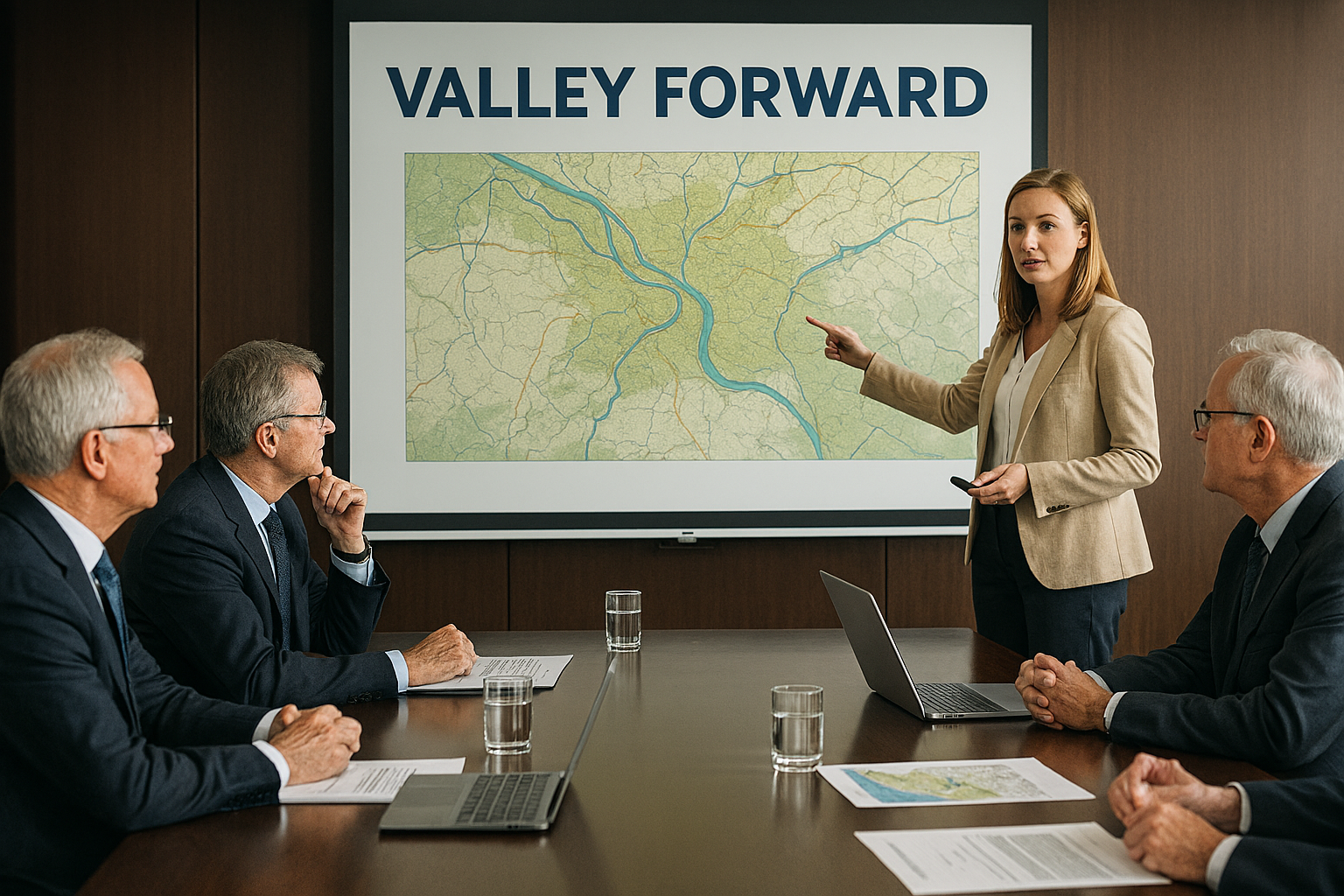
No More Sacrifices for Symbolism. That’s the phrase we must carry into every meeting, every planning session, every press conference surrounding “Valley Forward. It’s not just a slogan. It’s a demand. A line in the sand.
As Allegheny County and regional stakeholders unveil “Valley Forward: An Economic Development Strategy,” Black communities in the Mon Valley are being asked to trust the same legacy institutions and leadership that have historically excluded, displaced, and impoverished them.
But we’ve seen this movie before. And we know how it ends.
If “Valley Forward” does not center Black leadership, lived experience, and infrastructure needs from the start, it will become yet another blueprint for performative inclusion and economic erasure.
A History of Betrayal, Still Unfolding
The Mon Valley is not just a region; it’s a living archive of systemic abandonment. From the collapse of the steel industry to the rise of redlining, ADOS families have been locked out of opportunity and locked into basic survival for decades.
In 1937, federal redlining maps labeled Braddock, Clairton, McKeesport, and Duquesne as “hazardous,” cutting them off from investment and locking generations into poverty (Catapult Pittsburgh).
Today, 60% of blight in Allegheny County outside Pittsburgh is concentrated in the Mon Valley (Post-Gazette).
Pittsburgh ranks dead last, 76th out of 76 cities, for Black professionals in terms of economic opportunity, housing access, and community representation (New Pittsburgh Courier).
This is not just historical harm; it’s ongoing structural violence. And it’s why no more sacrifices for symbolism can be tolerated.
Gentrification Disguised as Development
“Valley Forward” promises to attract business investment, create jobs, and build long-term competitiveness. But the partners listed are some of the same legacy institutions that have historically planned over, not planned with, Black communities.
Without ADOS leadership directly at the table, redevelopment becomes displacement. “Opportunity zones” become extraction zones. And “revitalization” becomes a euphemism for pushing Black families out of the neighborhoods they built.
Pittsburgh’s Hill District and East Liberty stand as painful monuments to gentrification disguised as progress.
Once vibrant Black cultural hubs, both neighborhoods were systematically dismantled through urban renewal projects that razed homes, displaced families, and erased decades of community wealth.
In East Liberty, redevelopment led by East Liberty Development Inc. and supported by the communities elected representation at the time, brought in Whole Foods, Google, and luxury housing, but also skyrocketing rents and mass displacement of longtime Black residents.
The Hill District, gutted by the construction of the Civic Arena in the 1950s, still grapples with the loss of over 8,000 residents and hundreds of businesses.
Meanwhile, The Waterfront in Homestead, a billion-dollar retail complex built on the ruins of the steel industry, never translated into prosperity for Homestead’s Black population.
Despite its proximity, the jobs, wealth, and reinvestment bypassed the surrounding Black residents and their neighborhoods, leaving them in economic stagnation while shoppers and developers thrived just blocks away.
Health Disparities That Should Be a State of Emergency
Allegheny County’s own data reveals that Black residents suffer disproportionately from heart disease, cancer, and infant mortality. COVID-19 widened these gaps, with Black communities experiencing higher death rates and lower access to care (ACHD Mortality Reaport).
Even with a $5.5 million CDC grant to address disparities, the question remains: Why did it take a federal intervention to prioritize Black health in a county that’s been failing us for decades, and still is? (Post-Gazette)
Economic Development Without ADOS Is Economic Violence
Black communities are not just underrepresented, they’re structurally excluded. The Institute for Policy Studies projects that 50% of Black Americans are on track to have zero or negative wealth by 2053 (IPS Report). In Allegheny County, the median Black household income is less than half that of white households (Pittsburgh Equity Indicators).
If “Valley Forward” does not confront this reality head-on, it will become another plan that feeds symbolism while starving substance.
No More Sacrifices for Symbolism: Braddock Inclusion Project’s targeted solutions
Permanent ADOS representation in all planning bodies tied to Valley Forward and Allegheny Forward.
Dedicated funding streams for Black–led organizations focused on infrastructure, food sovereignty, violence prevention, autonomy, and youth leadership.
Community benefit agreements that guarantee protection against displacement and gentrification.
Public accountability dashboards tracking racial equity metrics in real time. And Narrative change campaigns that expose performative politics and elevate ADOS voices, just to name a few.
The Moment Is Now
This is not just about economic development. It’s about survival. It’s about dignity. It’s about refusing to be erased by the very plans that claim to uplift us.
No More Sacrifices for Symbolism means we will not be spoken for. We will not be planned over. We will not be left behind.
Let this be the moment we draw the line. Let this be the moment we demand more. Let this be the moment we authentically take our seat at the table, and build a future that reflects our truth, our labor, and our leadership.
Leave a Reply