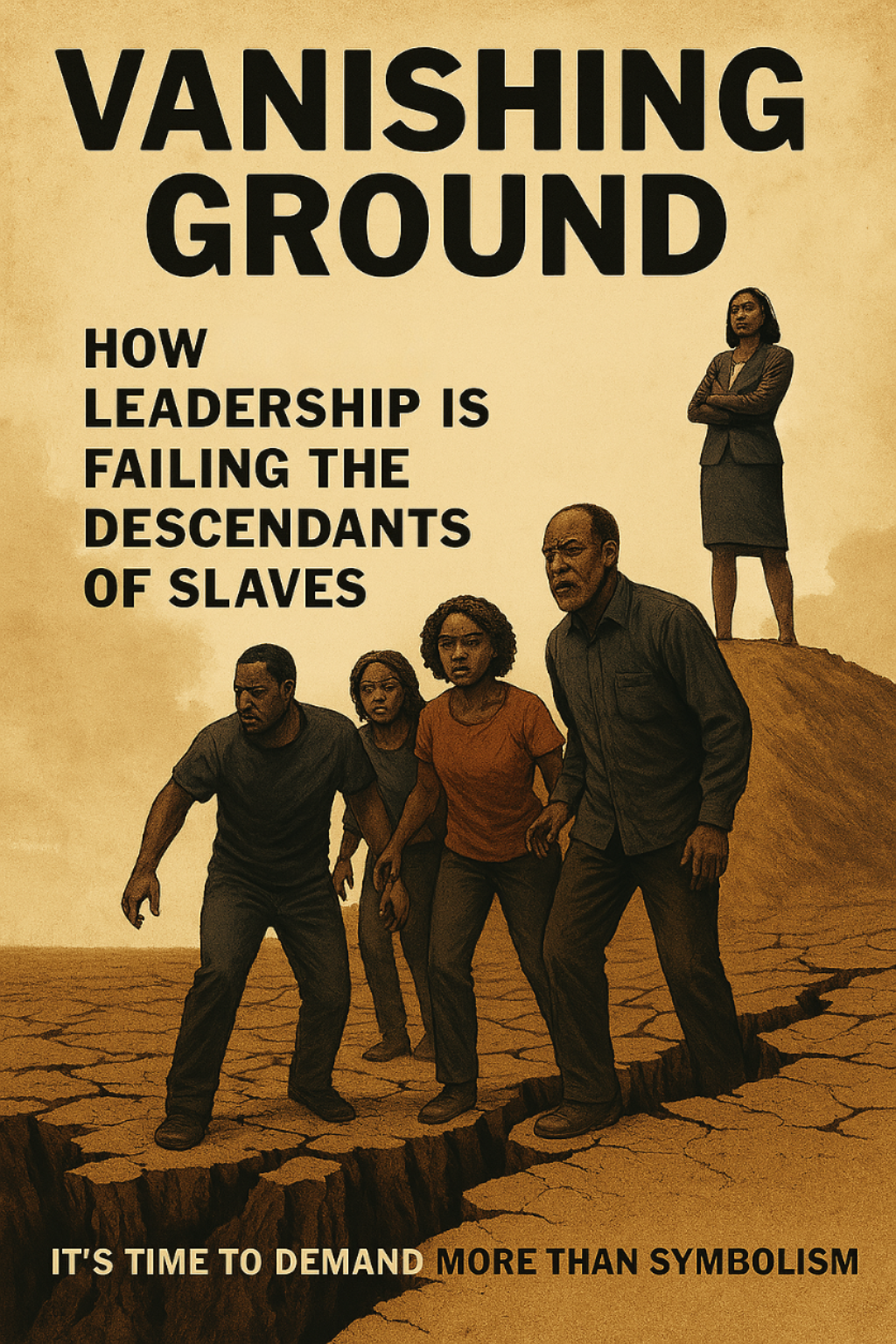
Vanishing ground. Vanishing Paychecks, Vanishing leadership. Vanishing Hope: The Black Workforce Is Bleeding Out
In June 2025, while mainstream America celebrated economic resilience, Black American Descendants of Slavery (ADOS) faced a devastating blow: unemployment surged to 6.8%, the highest level since January 2022 and up sharply from 6.0% in May. At the same time, the national unemployment rate dipped to 4.1%, and employers added a stronger-than-expected 147,000 jobs to the economy.
But beneath the glow of job growth, Black Americans were left behind. Unemployment declined among Whites, Hispanics, and Asians, making ADOS the largest unemployed racial group in the United States. This isn’t simply a lag in recovery, it’s a symptom of a deeper crisis: Vanishing Ground.
The Numbers That Demand Attention
According to the June 2025 Employment Report from the Bureau of Labor Statistics:
Black male unemployment rose to 7.5%
Young Black workers (ages 16–24) saw joblessness spike to 17.9%
An estimated 193,000 Black workers lost employment between May and June
In sharp contrast, White unemployment fell to 3.6%, Asian unemployment dropped to 3.5%, and Hispanic unemployment reached 4.8%. Across all metrics, Black workers are suffering disproportionately—even amid rising national opportunity.
Vanishing Ground: A Leadership Breakdown
While Black communities are hemorrhaging jobs, Black political leadership continues to lean on campaign optics and performative equity rhetoric.
Federal programs like the American Rescue Plan (ARP) and the Infrastructure Investment and Jobs Act (IIJA) were hailed as transformative—yet leaders failed to ensure tangible delivery to ADOS communities.
The Joint Center for Political and Economic Studies notes that Black joblessness consistently outpaces the national rate, with no major federal intervention tailored to ADOS.
Leaders celebrated the Justice40 Initiative, which pledged 40% of investments to disadvantaged communities, but analysis shows implementation lacked racial specificity and enforcement power.
Meanwhile, Black-led municipalities and officials celebrated federal investments that never trickled down. Schools remain underfunded, food deserts persist, and ADOS neighborhoods continue to decay—especially in historically Black towns like Braddock, PA.
DEI Gutted, Federal Jobs Slashed
The corporate backlash against Diversity, Equity, and Inclusion (DEI) has reversed hard-won gains for Black professionals. According to USA Today, Black executives are being pushed out of leadership roles at twice the rate of white peers.
Black Enterprise reported that 80,000 Black workers lost federal employment earlier this year due to cuts in Education, HHS, and Transportation, where Black employees are overrepresented.
These losses represent more than just statistics. They are the erosion of generational stability, upward mobility, and community anchors.
Global Priorities, Local Abandonment
While ADOS communities suffer, many Black leaders have turned their focus outward. Championing migrant relief and international solidarity, while ignoring domestic disparities.
They continue prioritizing foreign diplomacy over local employment pipelines, housing, and education equity. This political realignment, while once well-meaning and intended to build broader coalitions—has had the unintended consequence of leaving ADOS communities politically orphaned.
As a result, true unemployment rates for Black workers in some regions have exceeded 24%, while equity programs continue to favor generic “disadvantaged” criteria that dilute race-specific justice.
Missing Infrastructure, Missing Accountability
Infrastructure projects promised reconnection, revitalization, and racial repair. But as Johns Hopkins researchers revealed, some new highway and transit expansions risk repeating past displacement of Black communities, if they ever materialize at all.
Many cities failed to disaggregate spending data by race, leaving advocates unable to verify whether ADOS neighborhoods received promised funds (PolicyLink case studies).
What Must Be Done
We must stop confusing proximity to power with impact. Symbolic leadership is different from material gains. At the very least ADOS communities need codified racial equity, not just press-release pledges.
Community -led oversight of federal funds and programs and lineage impact audits across public and private sectors. Transparent employment pipelines connecting public investments with ADOS job creation.
For a blueprint of what’s possible, the Economic Policy Institute’s racial unemployment tracker remains a crucial guide.
Final Word: The Ground We Must Reclaim
Vanishing Ground is a tragic reality lived by millions, where symbolic equity evaporates and silence replaces strategy.
If Black leadership continues to chase headlines over healing and actual transformative progress, ADOS communities will be left with broken trust, empty pockets, and a fading stake in this economy.
With the rapid growth of AI, automation, and robotics this isn’t just about unemployment, It’s about basic survival.
Leave a Reply